
Prolouge

Source: photo by me (2026)
I left Korea for the first time when I was seventeen. I spent my school years in Manila. On the four-hour flight to the Philippines, and later during check-in, warm air wrapped around me. I had left on a winter dawn, half asleep, with my body stiff from the cold. That warmth melted everything at once.
The sky was bright. Maybe because of the humidity, it looked even clearer. I did not need an explanation to know this was a blessed city.
What felt even better than the clear weather were the Filipinos themselves. They always smiled and greeted me with “Magandang hapon,” which means “good afternoon” in Tagalog.
But something felt even warmer than their smiles. It was the crisp freshness of San Miguel, blending perfectly with the warm weather and the people.
There was a reason many Western retirees and former soldiers chose the Philippines as their final place to settle.
In any case, I was not an elderly gentleman retiring in the Philippines. I was there to continue my studies. As soon as the break ended, I enrolled in an international school in Bonifacio. I went there to study English. But before there was time to learn English, there came moments when I had to answer in English first.
My english sounded rude
I almost never spoke first. When someone gave me input, I processed it like a computer. I compiled the English into Korean in my head. Then I output English again. If I did not understand, I said, “say again?” When speaking to adults, like teachers, I added “please” at the end of the sentence.
As I struggled with English through reading, writing, listening, and speaking, a Korean friend who had lived there a long time spoke to me.
He said my way of speaking could sound rude. In some cases, it could even sound arrogant. Expressions like “say again” start with a verb. In English-speaking cultures, this can feel inconsiderate to the listener.
At first, I did not fully understand what my friend meant. Before long, I realized something important.
The first few words do most of the work
In English, the beginning of a sentence does most of the work. The first few words often decide the addressee, the tense, the core meaning, and even the tone.
After that realization, my English no longer sounded rude. At least, not anymore.
I could see that at least the first few words of a sentence form a single, tightly structured chunk. This chunk follows a strict word order. But the more important point was not that I discovered word order mattered in English.
The real change was in how I learned. I moved beyond using my native language as the default frame. I learned to see a new language as something new, on its own terms.
Once I stopped being bound by the built-in protocol of Korean, I could finally see the core operating principle of English.
At that point, the issue became clear. So what qualifies as an operating principle?
What is an operating principle
An operating principle must be the sine qua non of a language. The language cannot exist without it. It is like fond de veau in French cooking. Whether it is salad, fish, or meat, without this stock, it cannot be called French cuisine.
The same applies to language. An operating principle must be essential. It must be clearly distinguishable from other languages. At the same time, it must be predictable under its own rules.
Word order in English and Chinese is a clear example. That is why learning full sentences is an effective way to study English.
The same is true in other languages. French and Spanish mark grammatical gender. They use le masculin / le féminin and el masculino / el femenino. German capitalizes all nouns. For example, Der Teil und das Ganze. Vietnamese expresses relationships through kinship terms. Examples include anh, chị, tôi, and mình.
Many foreign learners complain that Korean has no operating principle and feels complex. This view misses the point. Korean has its own efficient internal logic. Without it, the language could not have survived for over 2,000 years next to China, with a shared border.
The real difficulty comes from habit. Learners used to word-order-centered languages fixate on word order. That way of studying creates confusion. It is only a Potemkin-style breakthrough, not a real one.
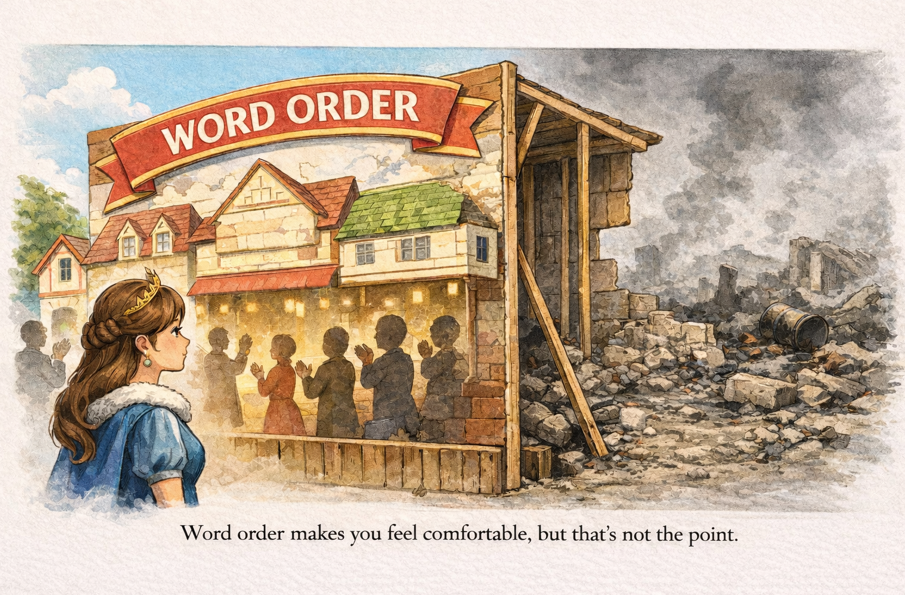
Korean’s operating principle: conjugation
Just as English places the subject at the front of a sentence, Korean places the verb or adjective at the very end. Korean has nine parts of speech, which are different from the eight Latin parts of speech.
Among them, only verbs and adjectives are conjugated words. All other parts of speech are unconjugated words.
Being a conjugated word means this. The stem, the meaning part, does not change. Only the endings attached after it change. For this reason, endings appear only with verbs and adjectives.
These endings appear in a fixed sequence. They mark subject-honorifics and tense. The ending that comes at the very end of a verb or adjective has three main functions. They are:
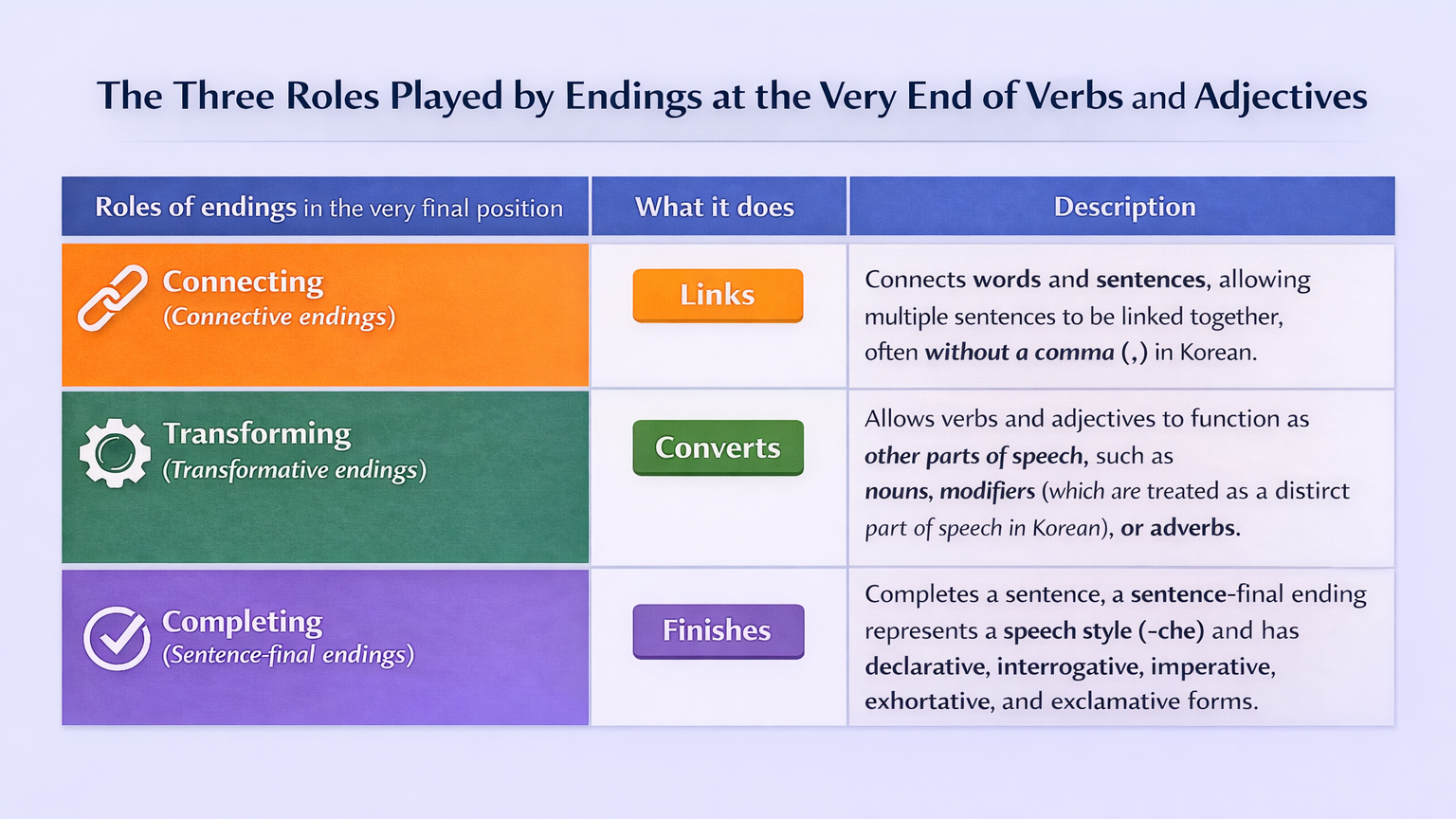
Endings: subject-honorifics, tense, and the ending that comes at the very end
For sentence-final endings, the formal speech style, -che, is called Jondaetmal. It expresses hearer-honorifics. One informal speech style is Hae-che. This style is called banmal.
In verbs and adjectives, the stem is the meaning part. It does not change. The roles carried out by the endings are collectively called conjugation. Unlike English, Korean conjugation works on a much broader and deeper level.
The example below shows how “먹다” (to eat) is conjugated.
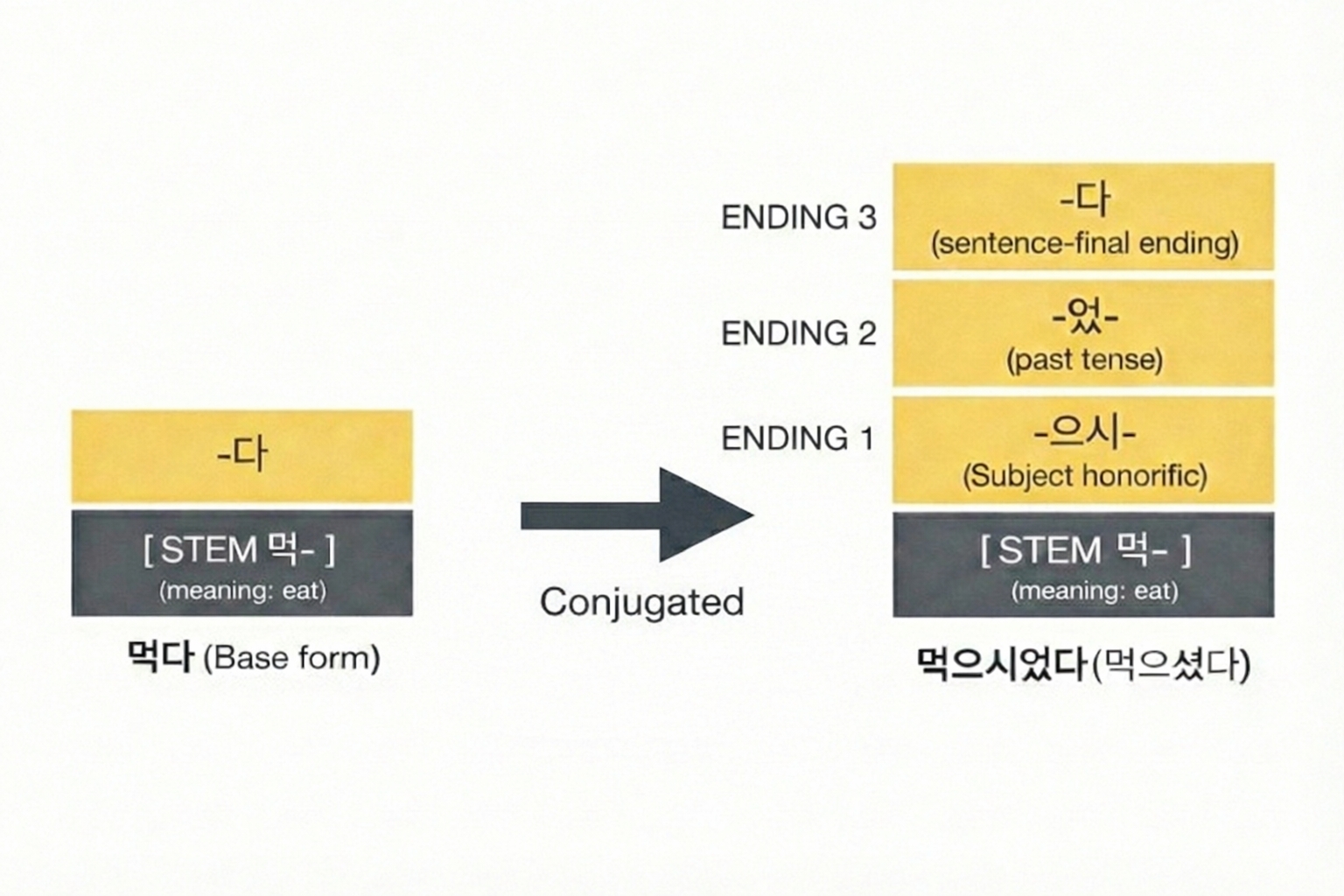
As you can see,
Korean conjugation is dynamic. Therfore, the meaning stays clear even when the subject or object is omitted.
Consider this situation.
In the living room, there are an older brother A, a father B, and a younger sibling C. The older brother A is speaking.
“먹으셨어요?” vs. “먹으셨어?”
Scene 1.
– 먹으셨어요? This means, “Dad, did you eat?” — Here, the implied subject is the hearer. Both the subject and the hearer are “Dad.”
Scene 2.
– 먹으셨어? This means, “Did Dad eat?” — Here, the subject is Dad, but the hearer is not Dad. The hearer is the “younger sibling”.
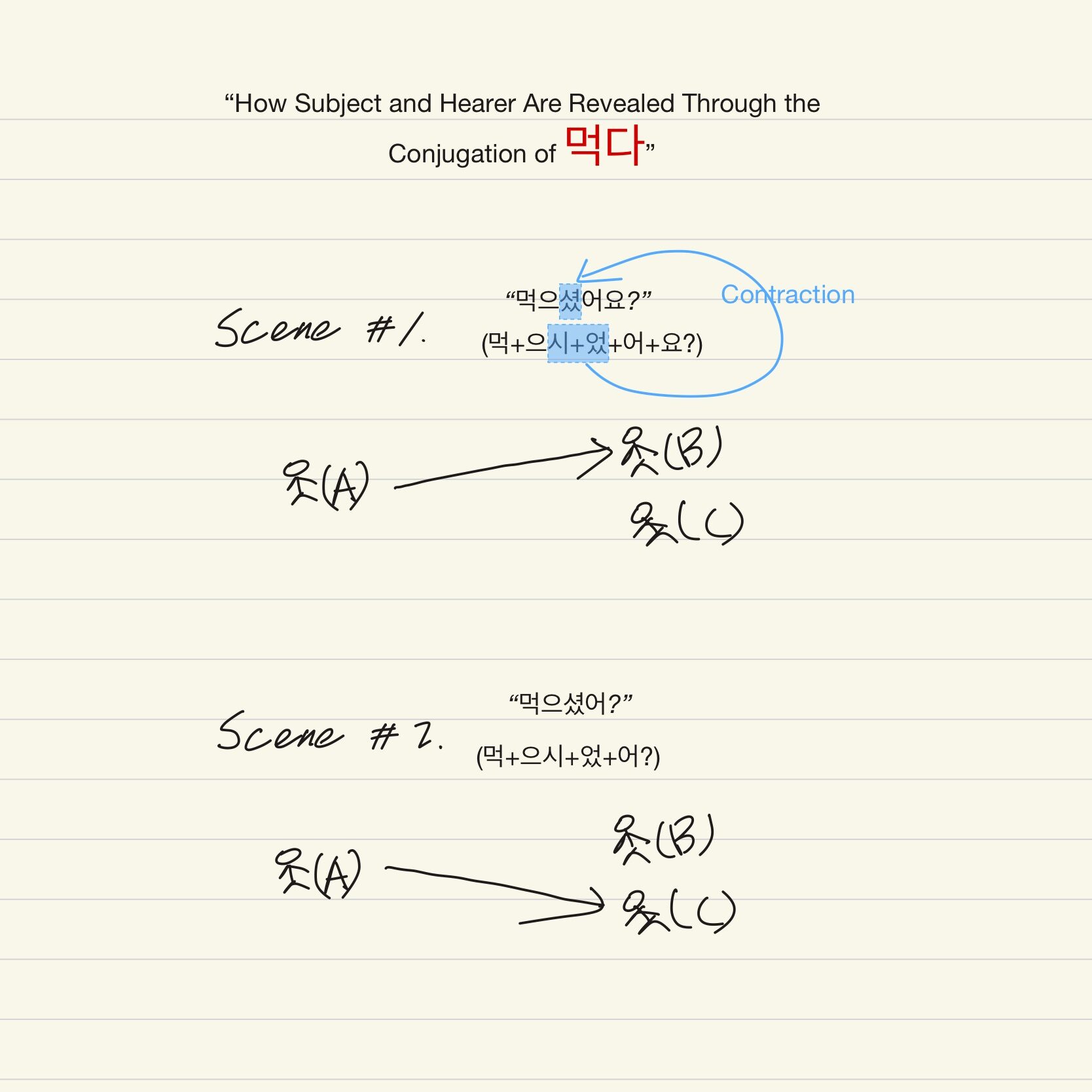
In Scene 1,
the subject-honorific (으)시 is used. Here, (으) is a linking vowel inserted to smooth pronunciation. The sentence-final ending is 어요?. This is the Haeyo-che(polite-informal) interrogative form.
For more -che, see:(https://en.wikipedia.org/wiki/Korean_speech_levels). (으)시 raises the subject of the sentence. Here, the subject is Dad. 요 marks Jondaetmal, which is hearer-honorifics. So it signals that the hearer is Dad.
In Scene 2,
the subject-honorific (으)시 is also used. This shows that the subject is Dad. The sentence-final ending is 어?. This is the Hae-che(casual-informal) interrogative form. 어? belongs to banmal. So it signals that the hearer is the younger sibling.
This feels very hard.
But this is basically the whole system of Korean. In Korean, the only conjugated words are verbs and adjectives. Everything else is an unconjugated word.
So when you learn Korean, it makes sense to study conjugated words first. And for these conjugated words, there are fixed rules.
In TOPIK, most sentence-final endings are built around the Haera-che declarative form. Also, subjects and objects are often written explicitly. So compared to everyday conversation, you have less pressure to track omitted subjects or objects.
The alpha product
Learning or acquiring something new is like building a house with no foundation. In that situation, an alpha product becomes the most important thing.

As of 2025, BYD surpassed Tesla in annual electric vehicle(EV) sales.
Earlier in its history, however, its CEO, Wang Chuanfu, achieved success at a time when EV charging infrastructure was almost non-existent.
Before battery charging infrastructures were widely built, how was he able to make the electric vehicle business succeed?
His chosen alpha product was the bus.
Unlike electric passenger cars, buses did not require high energy density. More importantly, they ran the same routes every day and always parked in the same place.
Because of this, they could operate even when charging infrastructure was still limited. The key point is this. Instead of waiting for infrastructure to appear, he first identified the ideal alpha product.
I personally believe that the alpha product for learning a new language is grammar. Nothing is more predictable than grammar yet.
This blog is a thin but sharp manual. If possible, I hope it becomes your alpha product. Once you gain predictability, even in a narrow area, learning changes. It becomes addictive. Small successes fuel ambition.
What you learned today:
- Verbs and adjectives are the conjugated words.
- The ending at the very end has three major roles. One of those roles is the sentence-final ending. It marks the speech style, called -che.
See the video links below for more details:
- 밥 먹다 can also be said as 식사하다: Well explained in my recent article—I also explained that when certain words entered Korean, they often became verbs or adjectives by taking the suffix -하다 in my Prolouge 2.
- More about speech styles (-che) and their forms:
- Emma’s seemile Korean language class 12
- Hangul & Korean class 41: This is Korean audio. But I bring it here because it is very useful for grasping the system. You do not need every single detail. It is enough to grasp the system itself. Copy the URL and paste it into NotebookLM. The best content can now be brought into your own language.
- More about honorifics:
More prolouges
- 2. Sentence-final endings (-che)
- 3. Korean Is an SOP Language, Not an SOV Language
- 4. Conjugation, Inside Out 1: The Connective Endings
- 5. Conjugation, Inside Out 2: Noun-Modifying Forms Of V/Adj.
- 6. How To Handle The Conjugations You’ll Encounter In Every Sentence And Paragraph
- 7. Conjugation and Contraction: It’s Time to Distinguish Them