
I personally do not like a top-down writing style. Once I know the ending first, the interest of the text fades fast.
That style also feels like an AI summary with no rhythm. It cannot carry the subtle emphasis hidden between the lines. But this prologue will be different.
Through this prologue, and likely the next one, you will understand what kinds of parts can appear in the P position in Korean. You will also gain the ability to build Korean sentences by yourself.
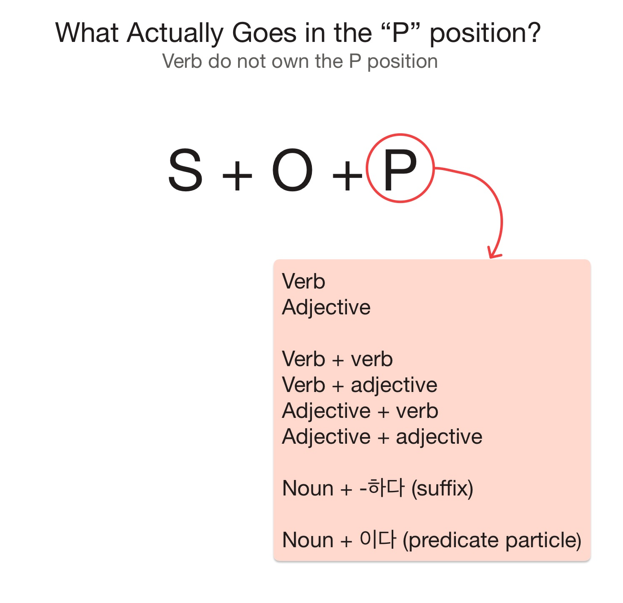
So far, we have seen that verbs and adjectives are conjugated with endings. Through different speech styles (-che), they close a sentence using sentence-final endings.
But the position is not enough
As seen above, these conjugated verbs and adjectives sit in the predicate position of the sentence. If Korean were a word-order-based language, this would be everything. There would be nothing more to explain.
And if that were true, then knowing that verbs and adjectives conjugate in the predicate position would already be enough. You should be able to make Korean sentences on your own. But that is not how it works in reality.
And likely, the reason you still cannot make sentences yourself is this: The conjugated words that can appear in the predicate position often leave their position. They show up across the sentence instead. (Remind that conjugation means the endings attached to the stem of verbs and adjectives)
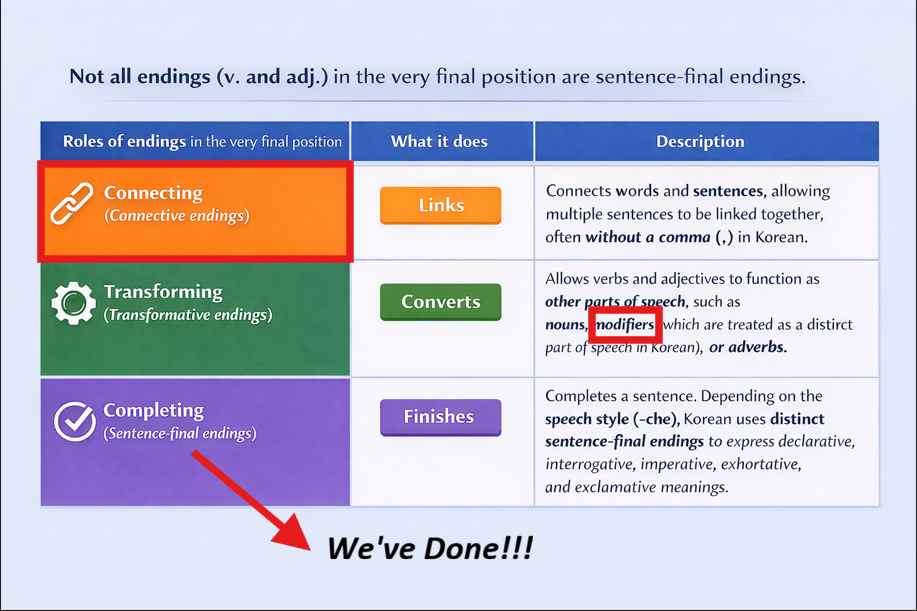
This kind of conjugation works in two main types, as seen above.
- Type 1: Connective endings attach to the stem of verbs and adjectives.
- Type 2: transformative endings attach and turn verbs and adjectives into modifiers.
Type 2: how Korean builds “will” and “can”
Here, the meaning of the second type is this. Verbs and adjectives gain the ability to modify the noun that follows them. The key point is this.
Unlike English, the noun-modifying form (verbs and adjectives) created by these transformative endings carries tense information while modifying the noun. The most important point is this.
These conjugated verbs and adjectives can modify all nouns. But they are especially used to modify dependent nouns. A dependent noun cannot stand on its own without a modifier.
Typical examples are “것”, “수”, “때”, “데”.
English has no grammatical category that directly matches Korean dependent nouns. When a noun-modifying form modifies a dependent noun, Korean gains functions that match English auxiliary verbs.
For example, “will do” becomes “할 것”, and “can do” becomes “할 수”. In addition, dependent nouns can take over the role of English conjunctions, such as 때 (when) or 데 (where).
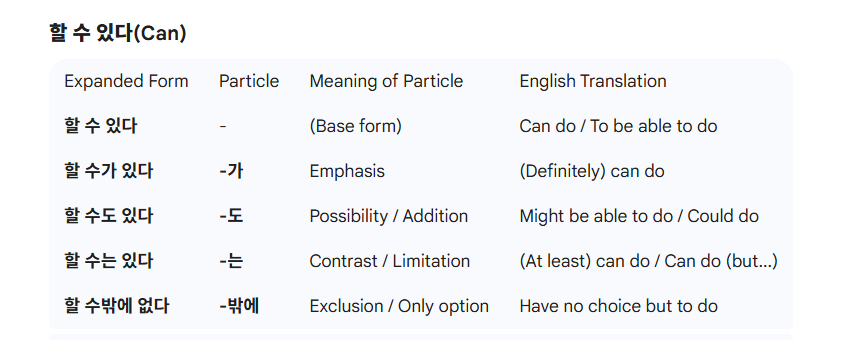
Further, a particle can attach after a dependent noun. (A particle is an unconjugated word, so it is not spaced.) Because of this, Korean handles fine meaning differences inside one system.
In English, you must add an adverb after an auxiliary, like “can probably“. Or you must place adverbs like “only” or “even” before conjunctions such as when. Korean integrates all of this within a single structure.
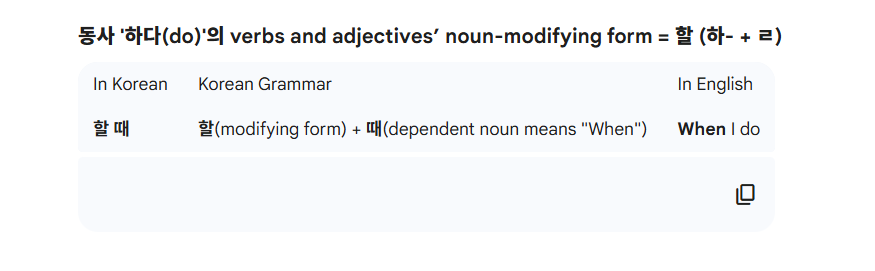
The example above is built using “때”, a dependent noun that carries the meaning of when.
Because 것, 수, 때, 데 are nouns by nature, they are dependent nouns. They receive modification from a noun-modifying form, and form a noun phrase.
That noun phrase can serve different sentence elements, such as subject or object.
I have only touched briefly on the second type here. I will explain it in more detail after covering the first type.
The grammatical structures of the first and second types are as follows:
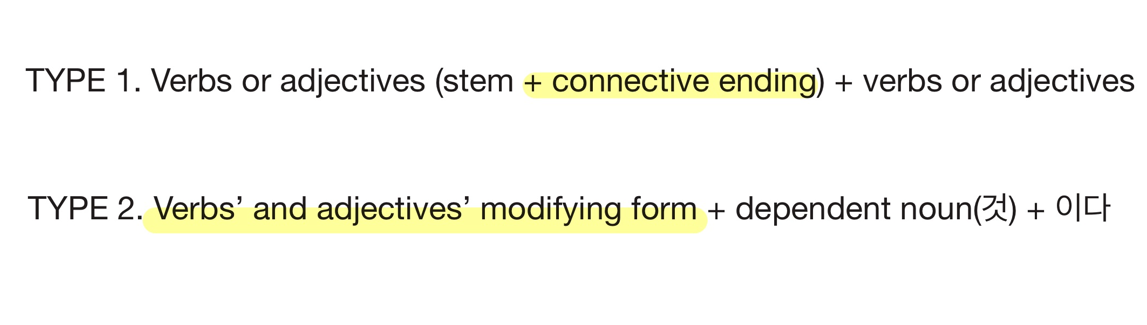
The first type and the second type can be used separately. They can also appear together in a single sentence.
Because of this, it is more effective to learn their features one by one first.
Now, let us look at the first type.
Type 1: connective endings: linking situations
In the first type, you first need to know what a connecting ending does, and what it connects.
A connecting ending connects “situations”. The situations it connects fall into three main ways:
- Independent situations: equal listing or contrast (and, but)
- Dependent situations: cause, condition, or background (because, if, so)
- Time-ordered situations: the timing or flow of events (as soon as, after, while)
This linking of situations is came true in two grammatical ways:
- A way that links one sentence to another sentence.
- A way where a connecting ending attaches to a verb or adjective and leads into the next verb or adjective.
You link situations by choosing the connecting endings that fit each situation. Here, I will use “-고”, an ending that means and, as an example. I will show its use through “먹고”, the conjugated form of the verb 먹다.
The first way is very easy. It is similar to English and. So I will replace the explanation with examples below.
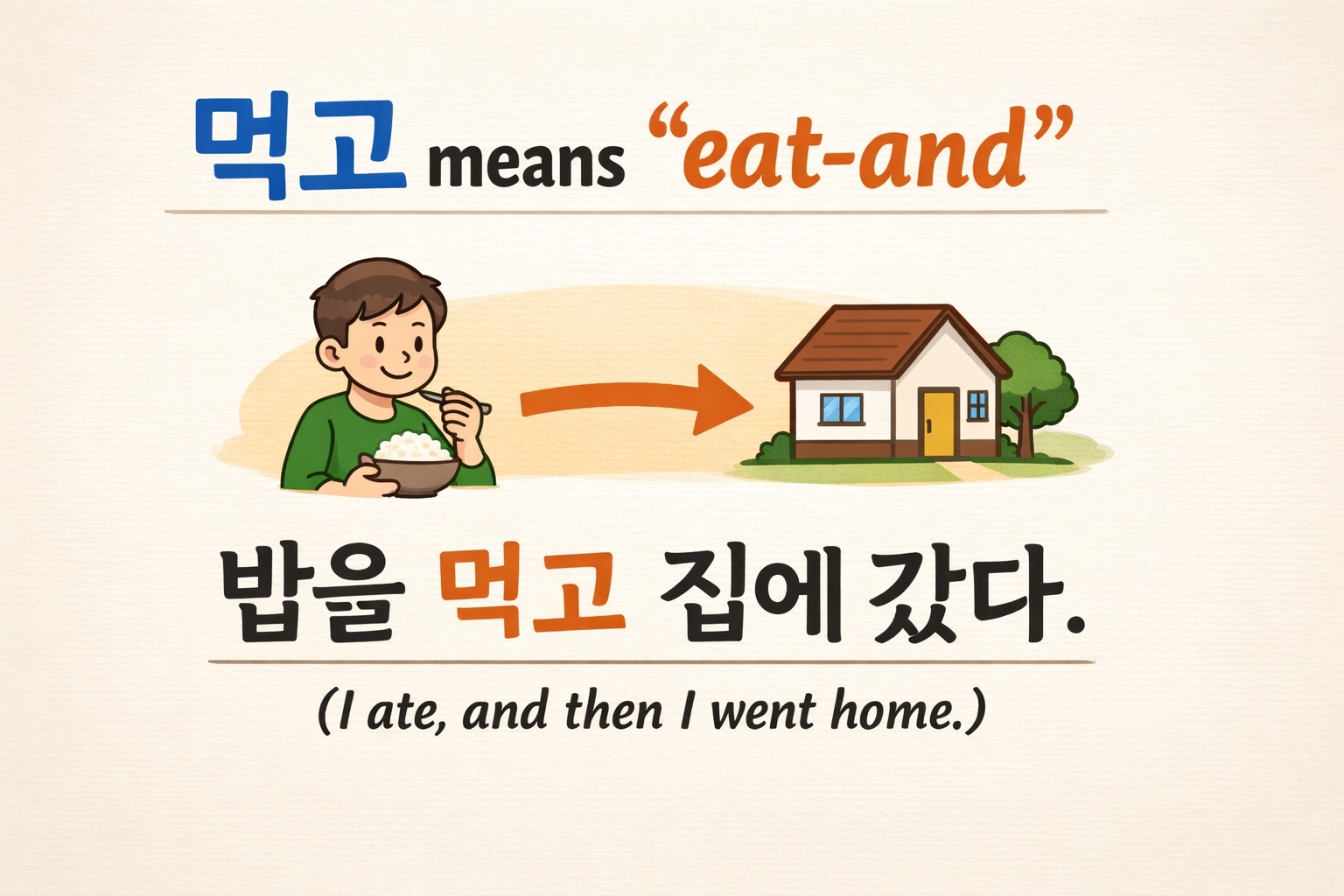
갔다 (went) is a conjugated form of the verb 가다. It uses -았-, the past-tense, so 가다 + -았- becomes 가았다, and then it contracts to 갔다.
In Korean, contractions fall into two broad types. One type comes from contracting unconjugated words—nouns + particles. The other type happens after conjugation. 갔다 is the second type of the contractions.
It would be better if you understood the whole sentence. But here, the key point is not the full meaning of the sentence. So I will skip a detailed explanation.
The second way
The second way is the most important. This is not just a matter of choosing a grammar form. It is because Korean ways of thinking are directly reflected in the system of grammar. But if you have followed my writing closely so far, you can likely predict this. You can expect that I will be able to help you reach full understanding.
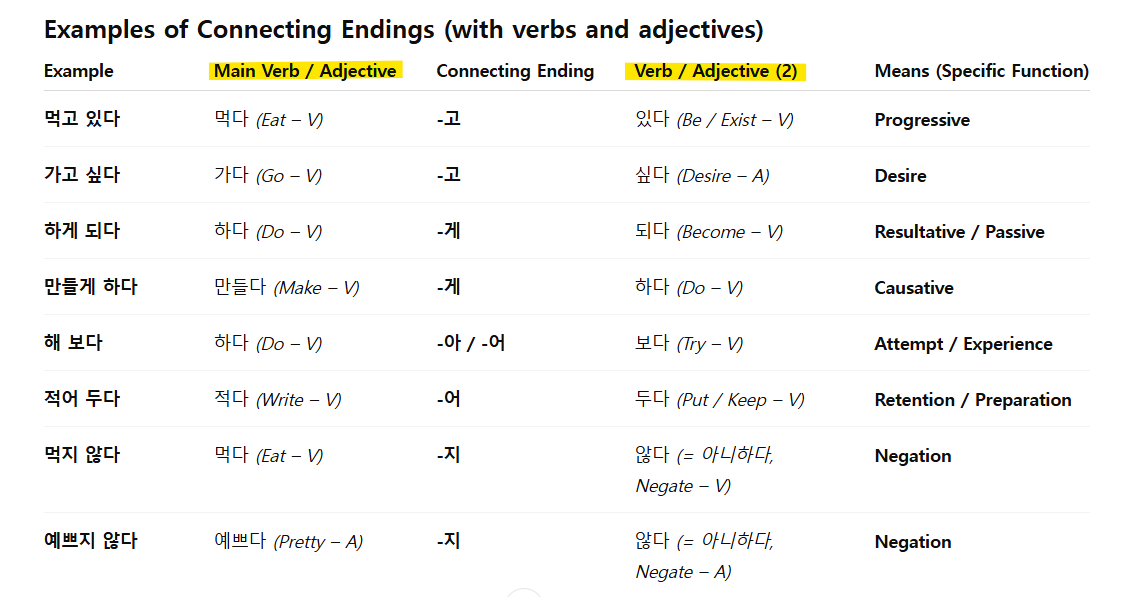
In the second way, “-고” plays a role similar to English to and and when linking verbs and adjectives.
However, some words that Korean treats as adjectives are the verbs in English.
Like this: want (verb) to eat (verb) = 먹고 (verb) 싶다 (adjective)
This difference shows up clearly in the idea of “want.”The Korean native word 싶다, which corresponds to English want, is not a verb; It is an adjective.
Because it expresses a state of wanting, 싶다 cannot stand alone; it needs content—typically a verb phrase, as in V-고 싶다. This shows how Korean treats desire or intention. It is not seen as an action, but as a state.
So Korean description does not stop at — an action happens. It is also organized to show how that action is understood as a state. In other words, it tends to mark the aspect of the action as well—such as ongoingness, completion, attempt, or guessing.
English organizes meaning around actions. Korean describes meaning in a more state-centered way. In this sense, adjectives are predicates in Korean.
If you want to express the “state of wanting” as an action in Korean, there are two common options.
- 원(願)하다: This is a Sino-Korean verb. It combines the character 願 (want) with the verb 하다 (do) to form 원하다. In Korean, a native word often exists as an adjective.
Then a Sino-Korean word with a similar meaning combines with –하다 (suffix) to form a verb. - 싶어하다: This turns the adjective 싶다 into an action-like expression.
It attaches the connecting ending -어 to 싶다 (싶어), and then combines it with the 하다, forming 싶어하다. Grammar books often explain this as the –“어 하다”. It is especially common when describing someone else’s desire, because from the speaker’s point of view it can sound more natural to describe the person’s wanting as an action rather than inner state.
Two more are: 있다 and 말다
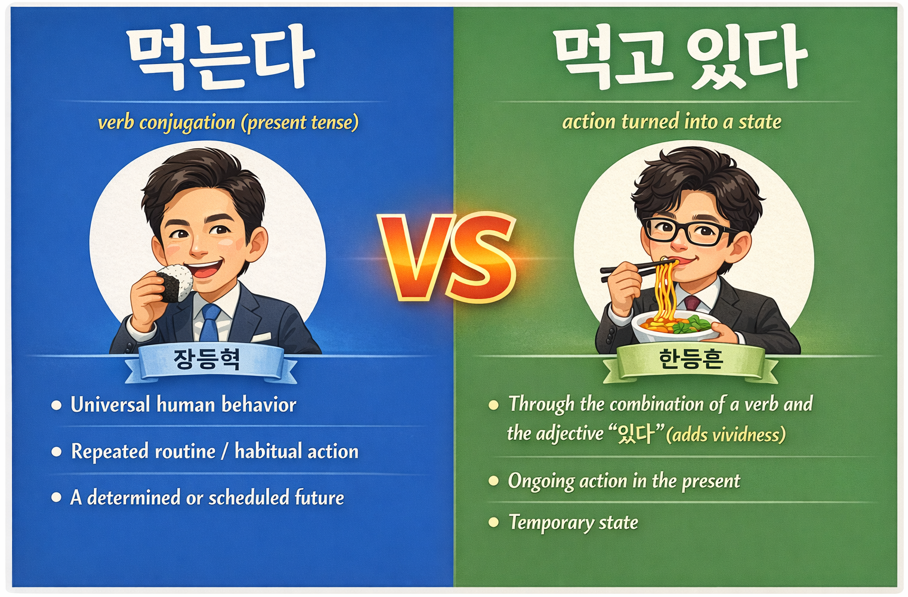
As explained in the earlier prologue, 있다 is also an adjective. The adjective 있다 expresses a state. This includes existence, possession, and an abstract condition being in place. The contrast below shows the nuance clearly. 먹는다 shows an action only. 먹고 있다 shows action plus state.
Another example is 말다. It appears in expressions like “하지 마.” 말다 is a verb that means stop. Because it is not an adjective, it can take imperative form, 마. 말다 can conjugate with the sentence-final ending -아 to become 말아. -아 is the hae-che imperative form.
In 말아, the ㄹ drop happens, so it becomes 마아. Then 마아 contracts to 마. Using the connective ending -지, you can form expressions like the followings.

It may look hard at first. But once you group it into a pattern, what you need to study next becomes clear. For learners who want more, I add a few examples below. I will skip detailed explanations.
A spoken shortcut that changes the meaning:
-지 아니하다 → -지 않다 → -잖아
More helpful for learners, -지(connective ending) 아니하다: This part is a very useful tip for real-life speech.
-지 아니하다 contracts to “-지 않다”. This expression can contract further to “-잖아”.
In this process, both the form and the meaning change.
Contraction 1: 밥 먹었지 않아?
- This corresponds to “Didn’t you eat?”: Like in English, the speaker is checking a fact that the listener already knows, or is expected to know.
Contraction 2: 밥 먹었잖아!
- This corresponds to“You already ate.”: The question’s meaning disappears. Instead, it becomes an emphasis on a shared fact between speaker and listener.
What you learned today:
- things that can appear in the P-position
So far, we have focused on conjugation where connective endings attach to the stem of verbs and adjectives. In the next prologue, we will cover the second type. It is conjugation where transformative endings attach and turn verbs and adjectives into modifiers.
This will be the final prologue on conjugation.