
Paul Graham, the co-founder of Y Combinator, defines pain like this: “The pain is a memory as soon as you feel it.” Building the basics, especially grammar, is hard.
It is not fun. It takes sustained effort. But that pain fades quickly. In the end, it remains only as a memory.
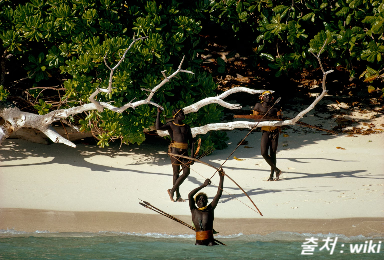
A protected island in India, home to the Sentinelese—an indigenous tribe living in voluntary isolation from the outside world.
If this alone does not bring comfort, imagine a near future where you go to North Korea and speak directly with children there. After North Sentinel Island, it is one of the most closed places on Earth, yet you can connect with its children through language.
That is a striking idea. Personally, I expect this to happen within 10 to 15 years. At this point, the motivation should be sufficient. So let us continue.
To repeat this again, in Korean, the only conjugated words are verbs and adjectives, and these conjugated words change through conjugations (the meaning part stays fixed). Conjugations include tense and subject honorifics. And the ending at the very end of a conjugated word has three main roles.
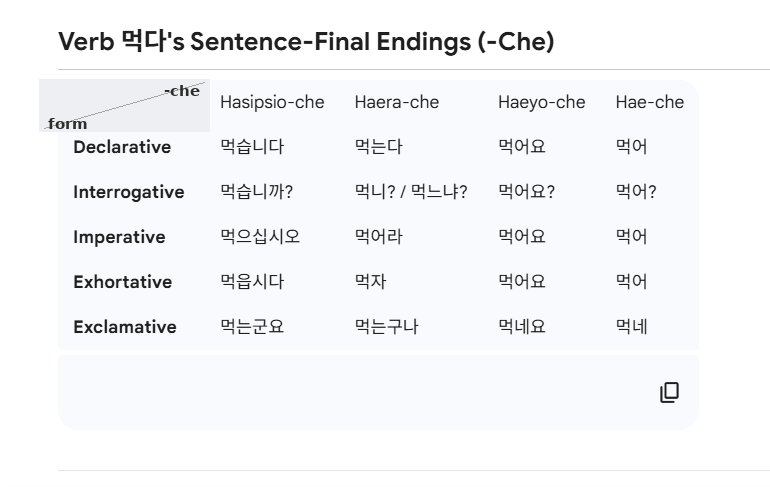
Sentence-final endings with 먹다
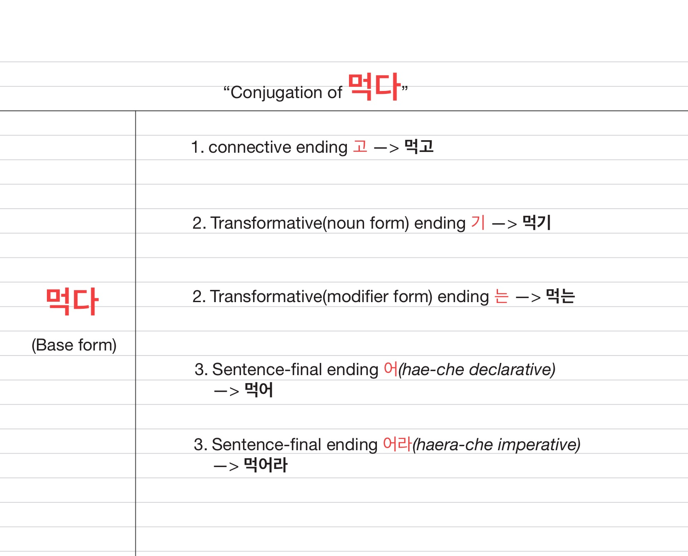
Let’s look at how the very last ending changes, using the verb “먹다.”
For now, you only need to focus on the sentence-final ending. The other endings, like connective endings and transformative endings (especially modifying form), will be covered in another prologues.
I’ll first show the full conjugation of the base form “먹다.” Then I’ll show how those conjugated forms are used in sentences.
My handwriting can be messy, so I’ll use my Galaxy Tab as much as possible—but please understand if it isn’t always neat.
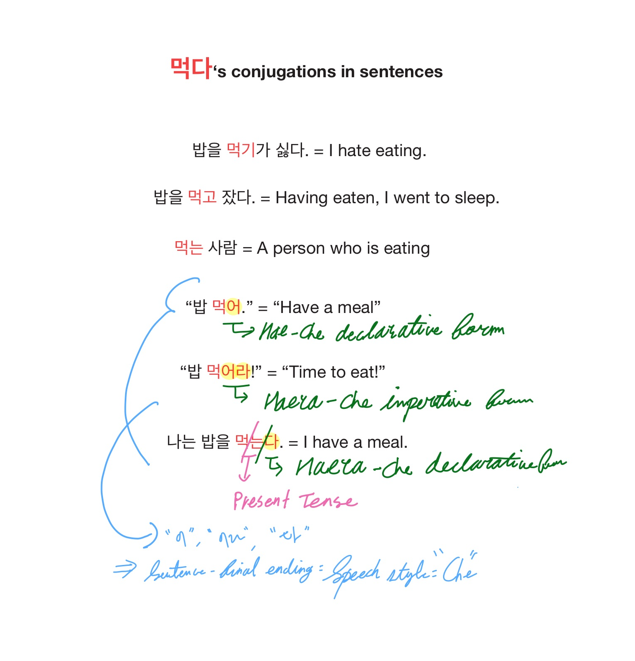
We use different sentence-final endings depending on the speech style (-che) and the speech form, like declarative or interrogative.
In this process, the meaning part, “먹,” stays fixed.
There are six types of -che, based on the verb “하다” (to do). These six -ches reflect the speaker’s attitude, and each one includes the five speech forms. In the examples below, I show only the four most commonly used -che.
You can find “먹어,” “먹어라,” and “먹는다” below the table
Regular vs. irregular conjugation and contraction
As I keep saying, when endings change, we call it conjugation. This conjugation is a combination of a fixed stem and the letters added after it, which are the endings.
There are three regular conjugation patterns and nine irregular ones. With the verb “먹다,” the meaning part (stem), “먹,” does not change during conjugation. That is why “먹다” is the easiest verb to explain.
The other regular patterns are ㄹ drop and ㅡ drop. These three are called regular because the drops happen in fixed conditions. Most of these changes developed to make pronunciation easier.
If this feels confusing, think of Saladin, the great Muslim leader of the 12th century. He fought Richard the Lionheart during the crusades. His full name was Ṣalāḥ ad-Dīn, but In English it became Saladin — The sounds were simplified for easier pronunciation.
A similar kind of simplification happens in Korean, too. You can think of these patterns like formulas, and we’ll organize them later.
In the table above, the Hae-che declarative form of “먹다” has the vowel “ㅓ,” so it becomes “먹어.”
The verb “가다,” which means “to go,” has the vowel “ㅏ,” so the ending “아” is added. This gives us “가아.” However, during actual use, “가아” is shortened to “가” to make pronunciation easier.
In Korean, there are two main types of contraction. One is simple contraction. The other is contraction after conjugation.
For example, in “먹으셨어요” on the main page, “셨” comes from [시 + 었] after verb conjugation. Contraction after conjugation can only happen with verbs and adjectives, because conjugation must come first.
This was one of the hardest parts for Western missionaries in the 19th century when they learned Korean.
They often confused simple contraction with conjugation itself. I will dedicate a full prologue to this topic later. Once you understand this, you can clearly distinguish conjugated words from unconjugated words. After that, with enough exposure to many different sentences, you will have essentially learned all of Korean.
Why 하다 Is special (하여 → 해)
The conjugation of the verb “하다” (do) belongs to irregular pattern. As you saw with “먹어” and “가,” when the vowel in the meaning part is “ㅏ” or “ㅗ,” the ending “-아” is added. In all other cases, “-어” is added.
However, the verb “하다” (do) does not follow this rule. When the endings “-아” or “-어” come after the meaning part “하-,” they change to “-여.” As a result, “하다” conjugates as “하여.” After conjugation, “하여” is shortened to “해.” This irregular pattern appears only in the verb “하다.”
This single irregular conjugation became the basis for the -che system, (Hae, Haeyo, Haera, and others) because the verb “하다” plays two important roles beyond simply meaning “to do,” as in English.
- “하다” works like a light verb/auxiliary that turns nouns (and sound-symbolic words) into events, adding the meaning of performing or occurring.
- “하다” itself is used as a suffix to create new words, such as “공부하다” (공부 + 하다). When the loanword “sexy” entered Korean, it formed the adjective, “섹시하다” (sexy + 하다).
Because of this productivity, “하다” was chosen as the reference point for the -che system.
Since it uses “-여” instead of “-아/-어,” if you try to match the -che of other verbs or adjectives directly to “하다,” they will not line up.
For personal study, you can use Gemmi to look up every -che and every form of verbs and adjectives. It is an especially useful tool for language learners, particularly those studying Korean.
More helpful for learners: What Is “요”?— sentence-final ending vs. honorific particle
This part is a very useful tip for real-life speech.
Hearer-honorifics include the formal-polite “-습니다” and the informal-polite “-어요.” Until now, I said a sentence-final ending always ends a sentence. Without the sentence-final ending “-습니다,” a sentence cannot be complete.
But with Haeyo-che, the sentence can still be complete even without “요.” If you remove “요,” it becomes Hae-che.
Here, “요” is an honorific particle.
In Haeyo-che, “-해(하- + 여)” is the real sentence-final ending, so the sentence is complete even without “요.” “요” mainly adds the informal-polite nuance.
The honorific particle “요” can attach not only to sentences, but also to single words. This pattern is very common in real Korean speech.
To be honest, in daily life, I do not say the subject or object in full sentences. Many Koreans who start learning English say only single words instead of full sentences. This comes from this Korean way of speaking.
Here are some examples:
- “커피 (coffee)+ 요?”, “담배 (cigarette) + 요?” (you mean coffee?, you mean cigarette?)
- As an answer to “Where were you?”: “학교/에서/요” (at/school/요)
One thing to be careful about is that with “-이에요/예요,” which is the conjugated form of “이다,” the whole form functions as a sentence-final ending. If you remove “요,” the sentence becomes incomplete. So in this case, you cannot omit “요.”
I will close by quoting Samuel Johnson to summarize the use of “요,” which can function both as a sentence-final ending and as an honorific particle—even without “요,” the sentence is still complete; in other words, when “요” functions as an honorific particle, it serves to add politeness to an already complete sentence.
Samuel Johnson, Preface to A Dictionary of the English Language (1755)
Every language has its anomalies, which, though inconvenient, and in themselves unnecessary, must be tolerated among the imperfections of human things, and which require only to be registered, that they may not be increased, and ascertained, that they may not be confounded.
What you learned today:
- If you learn Korean, the day you can speak directly with children in North Korea is not far away.
- You also learned the deeper idea behind -che.
In the next prologue, we will study the difference between verbs “먹다” and adjectives “예쁘다” in Korean.

See the video links below for more details:
- Distinguishing banmal from honorific particle 요: watch 1:19—1:25
- If you want to learn more about the different -che forms using 하다: watch: Lingodeer