

We have been running for a long time. Now we slow down and catch our breath.
I want to tell a story about Western missionaries who came to Joseon (the Korean dynasty before modern Korea) in the 19th century.
This may interest you. They are like the ancestors of today’s Korean learners like you. They were early Korea experiencers who stepped onto the land of the Hermit Kingdom, Joseon.
This is a short break for a historical moment.
Not the land of morning calm
Nineteenth-century Joseon was even more backward than what people today call a “banana republic.”
Recent comments by president Trump made that term controversial, but Joseon was far worse. In polite words, it was called the Hermit Nation or the Land of Morning Calm.
In reality, it was nothing like that. The whole society lived in extreme poverty. Living conditions were harsh. Women lacked enough fabric for clothing. Their jackets became shorter and rose upward, often exposing their chests.
One foreign scholar who traveled in Joseon wrote this.
Many people lost all their teeth before the age of thirty. Some could not even pronounce words clearly because of that.
Perhaps the clearest way to picture what that meant in everyday life is to look at a place many foreigners recognize today: Cheonggyecheon.
It is now a polished landmark in central Seoul, but its past tells a different story. The images below trace its transformation—1904, 1976, and 2023

The photo on the left (1904) isn’t very clear image, so I’m attaching the 1976 one, too. It’s the same place.

1852: two Kings, two futures

Meiji Tenno and Gojong, the king of Joseon at the time, were both born in 1852. They were the same age. But their choices were completely different.
One side went through the Meiji Restoration. It pulled the country into the center of the world. The other side held on to isolation until the end. Isolation (쇄국, 鎖國) meant exactly that. It meant locking the country with chains.
Gojong wanted the people to remain a “hermit nation”. They did not want change. At that time, Joseon still served the Ming dynasty.
The Ming had been founded in 1368 and destroyed by the Qing in 1644. But Joseon believed the spirit of Ming did not die with the Ming. They believed it was still breathing on Joseon soil.
Kim Ok-gyun and the enlightenment party

On the far right, Kim poses with his hand inside his jacket—the iconic Napoleon pose, once copied by would-be modernizers and ambitious elites around the world.
A group emerged to break this feudal order. They were called the Enlightenment Party. One leading figure was Kim Ok-gyun. Through close exchange with Fukuzawa Yukichi, the father of Japan’s modernization, he was strongly influenced by his ideas.
Kim also came from a traditional elite family.
When the Enlightenment movement failed, Kim Ok-gyun fled to Japan. Later, he was assassinated in Shanghai by an agent sent by Gojong.
At that time, the Han River was not yet developed. Sandy beaches and ferry docks still remained.

His body was moved near Yanghwajin, one of those docks. It was publicly dismembered. His head was displayed at Yanghwajin with a white cloth. The cloth read, “Great traitor Kim Ok-gyun.”
The remaining body parts were cut up and shown across the country. Foreign diplomats in Seoul strongly objected. But the execution went ahead.
The punishment followed the Great Ming Code. That law came from the Ming dynasty, which had collapsed 400 years ago.
Later, a Japanese man recovered Kim’s head. It was buried at a temple in Tokyo.
At that time, ferry docks were the busiest places.
They were where people passed most often. So his head was displayed in the most visible spot. (The picture below is Mapo-gu back then)

Photos of the execution can still be found online. But they are not appropriate to show here. Instead, I refer to a photo published by Jiji Shinpo, which widely reported this incident at the time.

Jeoldusan, the beheading mountain
Behind the ferry dock where his head was displayed stood a cliff called Jamdubong. The name came from its shape. It looked like a silkworm lifting its head.

About thirty years before Kim Ok-gyun was executed, this place saw something else. In the mid-19th century, a large Catholic persecution happened here. Thousands of Catholics were beheaded and died as martyrs.
After that, the mountain changed its name. It became Jeoldusan, meaning “Beheading Mountain.”
Facing this blood-named hill is a cemetery built much later. It is the Yanghwajin Foreign Missionary Cemetery. The graves of Western missionaries and believers its look directly toward Jeoldusan.
Today, this place is the largest martyr site in Korea. In 1984, Pope John Paul II visited Korea and came here first.
Mother Teresa also came here to honor the martyrs. Even now, people come from all over the world to pay respect.

At the same site, there is also an anti-foreign stone stele. It was erected during the executions of Catholics.
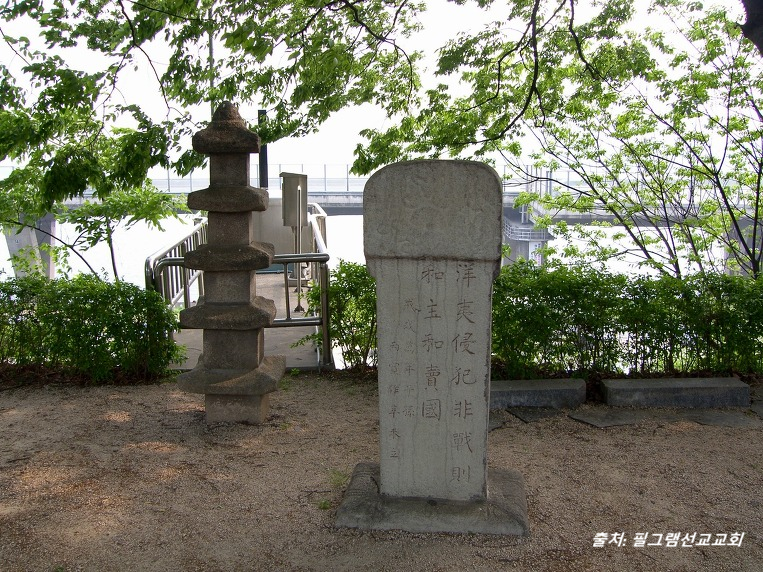
Its message says this.
If Western barbarians invade and we do not fight, that is calling for peace. Calling for peace means selling the country.
When you read these words, the tension of that time becomes clear. So does the scale of the historical tragedy.

The building in the photo is the new headquarters of YG Entertainment. It is a leading K-pop agency.
It produced global idols like BIGBANG and BLACKPINK. Through music production, it helped bring K-pop to the world. The martyrs executed here and Ok-gyun could not have imagined this future.
They could not have imagined that Yanghwajin, soaked with their blood, would later be linked to artists reaching two billion views worldwide. This contrast feels like a requiem for their spirits. Boombayah.

If you are in Korea, or plan to visit, I personally recommend stopping by this place. You can feel one hundred years of change in a single spot.
Back to grammar
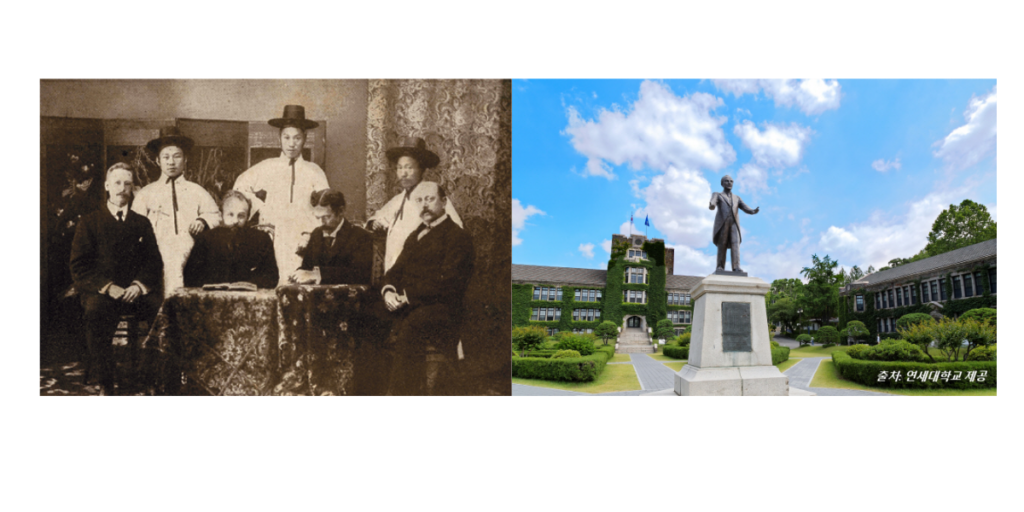
This has gone on a bit long. Now we return to the story of the missionaries (not the executed). In any case, Joseon was that kind of country.
The French and German missionaries who came here were not tourists. They likely came with a mindset like Charles Darwin visiting the Galápagos. Or Clifford Geertz going to Bali.
They came out of cultural and anthropological curiosity.
They studied Korean from a contrastive linguistics perspective. They tried to divide Korean parts of speech using their own native language systems. Because of this, confusion appears throughout their work.
Particles, not prepositions
This was especially clear with French missionaries. They compared Korean particles to French prepositions like à Seoul (“Seoul에”) or avec Marie (“Marie와”). Based on this, they tried to understand Korean particles as postpositions.
Contraction, not declension
They also looked at verb and adjective forms we discussed earlier. They tried to understand them as inflection, like eat–ate–eaten.
Soon, they noticed something important. In Korean, the stem does not change. Only the ending changes. At that point, they began to question their original framework.
They also used declension as their frame. They looked at English I / my / me, German Ich / Meiner / Mir / Mich, and French Je / Me / Moi. They understood Korean 나 → 내가(I) / 내(MY) / 날(ME) in the same way.
In other words, they confused two different things. They treated phonological contraction(or reduction) as declension.They thought they were the same process. If you are beginners, you are probably not very different from them.
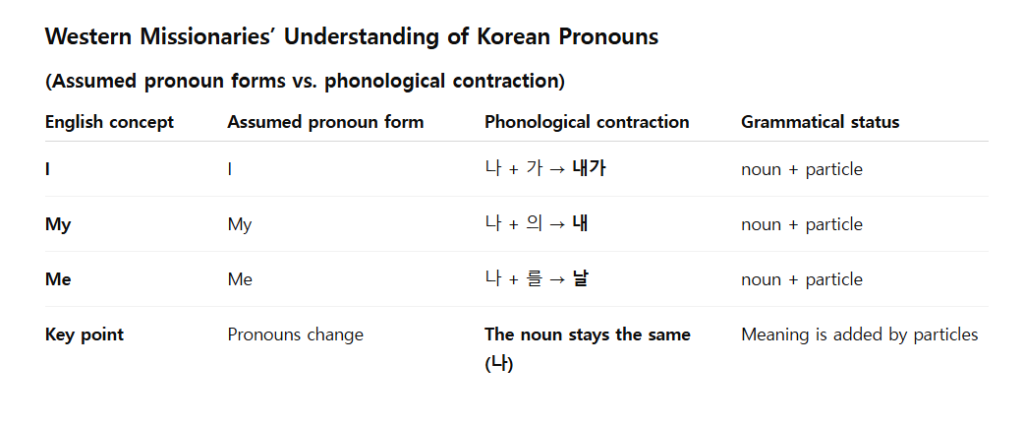
But 내가, 내, and 날 are all built the same way. They are 나 + 가, 나 + 의, and 나 + 를. This is not postposition or declension. It is a particle. What Westerners thought was declension was not declension.
It was a sound change caused by unconjugated words meeting each other.
That is why Korean language programs (Like Sungkyun Language Institute) teach these changes separately. They are called palatalization, liaison, and nasalization.
In Korean, these sound changes are grammatically allowed. In the end, you must understand this kind of phonological contraction. Only then can you clearly separate conjugated words from unconjugated words.
Two types of contraction
There are two main types of contraction in Korean. One happens when unconjugated words meet each other. It usually appears when a noun combines with a particle.
The other happens after conjugation. As mentioned in the first essay of this blog, a good example is the conjugation of 먹다 (to eat). 먹-으시-었-어요? Becomes 먹으셨어요?.
Missionary, not mercenary
When I briefly wrote about missionaries, one idea stayed in my mind. Jeff Bezos made this contrast famous: Missionary vs Mercenary. I hope the materials I have made, and will keep making, move you a little closer to the missionary side—curious, patient, and committed to the long game, even when progress feels slow.
Studying Korean can feel messy at times. You may start with clear reasons. But along the way, it is easy to lose direction. And slowly, you drift toward the mercenary side—impatient, distracted, and easily discouraged.
There is one more interesting fact. Today, South Korea records at the top 3 missionary-sending countries in the world with America. The missionaries who first stepped onto Joseon land in the 19th century could not have imagined this scene. Not even once.
What you learned today:
- There are two types of contraction in Korean. This contraction helps you distinguish unconjugated words from conjugated words. Along the way, you also saw a small part of Korean history.
In the next essay, I will look at common cases of contraction. These cases help distinguish conjugated words from unconjugated words. This section went a bit long. It covered history as well as grammar. We will meet again in the next essay. It will likely be the final one.