

Jang Dong-hyuk writes an essay during a hunger strike. The tent behind him stands in the Rotunda Hall of the National Assembly, where he is holding a sit-in protest.
Here is Jang’s Facebook post, written on day 7 of that hunger strike:
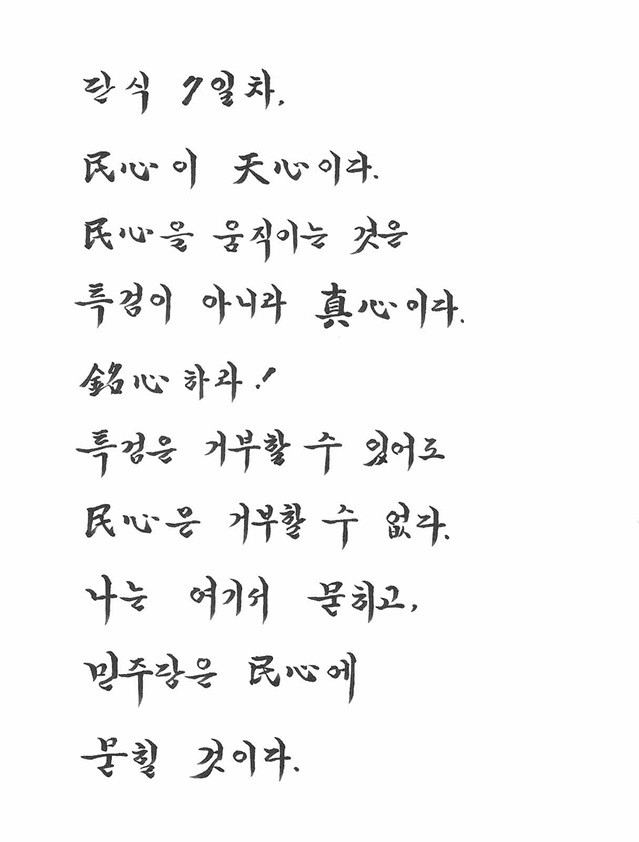
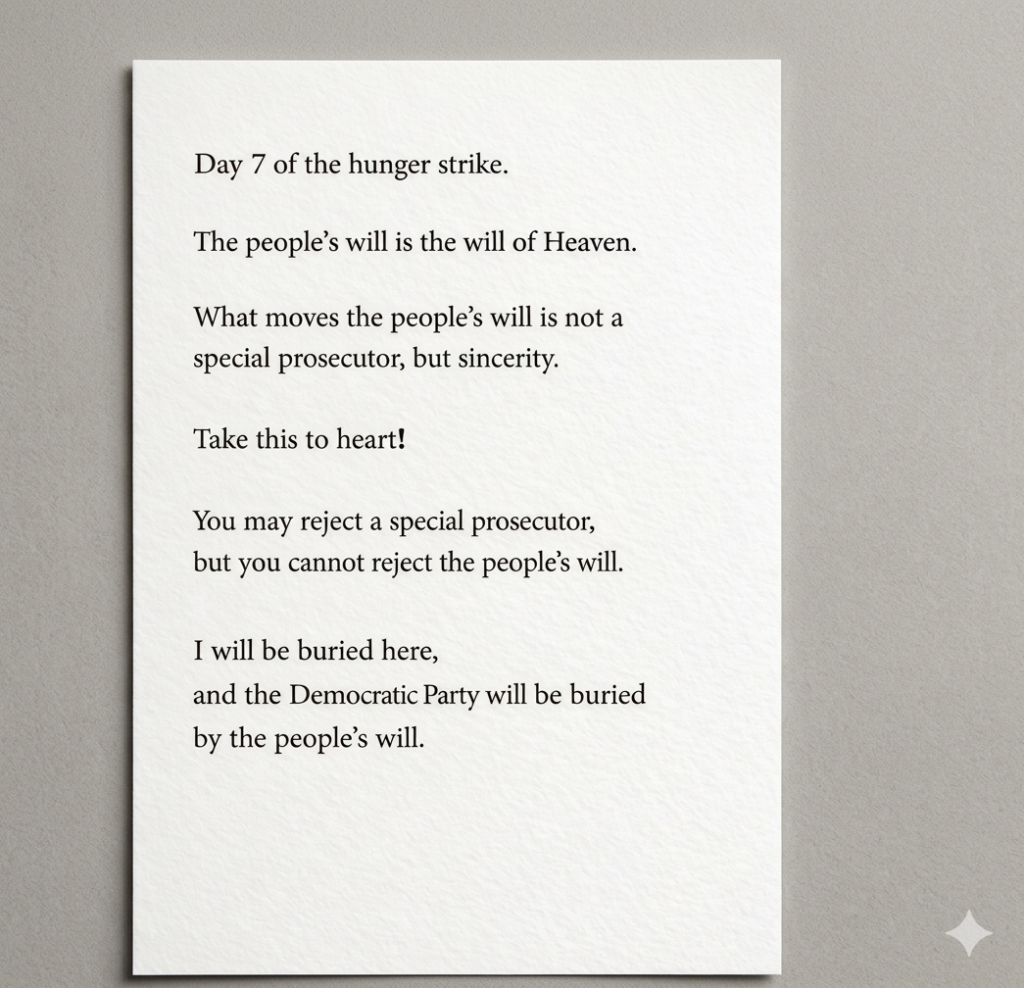
For readers who want to compare it with English, I included an English translation as well. I received help from Gemini for generating the image.
Follow the steps and do it the same way
It is a striking and rhetorical political statement.
Separate from its political message, the key question is whether we apply what we have learned so far.
I will show you how I apply what we have learned to sentences. First, I identify which words are conjugated and which are not. Then, I classify the conjugated words by the three major roles of conjugation. That is all.
You can use the same method for any other sentences you encounter.
For readability, I will use different colors as follows. If my handwriting is hard to read, please understand.
- Conjugation 1: Sentence-final ending (green color)
- Vocab: “천심(天心)이다 (is will of Heaven)”, “진심(眞心)이다 (is sincerity)”, “명심(銘心)하다 (take this to heart)”
- How it is used in Jang’s post: 천심이다, 진심이다, 명심하라!
- Conjugation 2: Connective ending (blue color)
- Vocab: “묻히다 (to be burried)”
- How it is used in Jang’s post: 묻히고
- Conjugation 3: modifying form (red color)
- Vocab: “움직이다 (to move)”, “거부하다 (to reject)”, “묻히다 (to be burried)”
- How it is used in Jang’s post: 움직이는, 거부할, 묻힐

The “-다.” is mostly used for stating facts, organizing thoughts, or explaining principles rather than directly speaking to someone (like -아/어요). It is commonly found in diaries, news headlines, academic writing, philosophy, or monologue.
In Jang’s post, before “명심하라,” he consistently uses the “-다.” to state truths and principles.
Then suddenly, he shifts to: “명심하라!”
This is the Harae-che imperative form. Unlike the previous sentences, it directly addresses the Democratic Party and commands them to “take this to heart!”
Without understanding -che, it is difficult to notice this subtle but important tone shift.
You can do it the same way I do
It may seem difficult at first. But learners who follow along with me will gain confidence that this method is very effective. It is the fastest way to study Korean.
Studying Korean can feel like solving Sudoku. That intuition is accurate. Learning Korean works much like a logic exercise preventing dementia.
The key point is this. You must fully understand the conjugations. Then you clearly separate conjugated words from unconjugated ones.
I use the text written above by Jang as an example. I include word list for learners who want to study which words are conjugated and which are not:

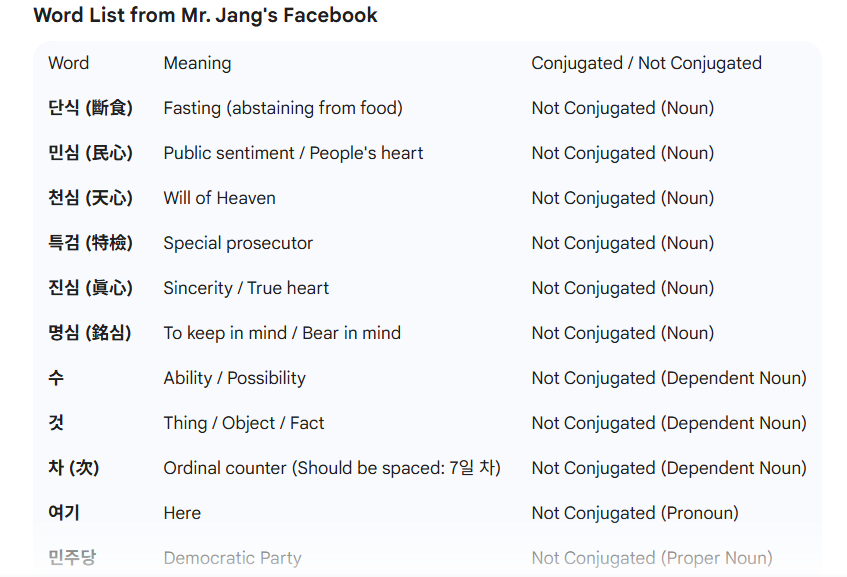
Now you know the right way to study Korean. By following this approach, it helps you to develop the ability to read and write.
More importantly, this method allows you to internalize words and learn them by heart. By contrast, words in a word list exist only for memorization. They are dead pieces of wood.