Category: Korean Conjugation

  • Internalizing Korean Contractions


    Internalizing Korean Contractions


    Now it is time to learn about contractions.

    Korean contractions are different from English ones. In English, even if learners do not know the exact meaning of a contraction or abbreviation, they can still see that something has been shortened. There is a visible signal, such as an apostrophe (‘) or a period (.).

    In Korean, however, contractions are often harder to notice.They blend into the word itself. 
    Example Korean sentence for contraction

    Why Korean contractions are less visible

    The reason is simple. Korean contractions often begin as phonological reductions. This allows different parts of speech to combine into a “single” word.

    These forms become part of the grammatical system itself. In English, by contrast, contractions are usually treated as standard shortened forms.

    Korean podcast

    I also noticed this in Korean-learning podcasts. Hosts often try to be considerate toward learners by pronouncing words carefully and clearly.

    But even then, they still unconsciously pronounce words in their contracted forms. This can confuse learners because different parts of speech can combine into a single word.

    Since Korean speakers are much more familiar with contracted forms, learners should remember that native speakers usually do not speak with this kind of consideration in mind.

    To use Korean in real life, learners need to know that contracted forms are not unusual. They are a standard part of everyday speech.

    Common Korean contractions for TOPIK

    TOPIK exam

    Fortunately, TOPIK usually uses full forms rather than contractions. The contractions that do appear are relatively limited and predictable.

    This is because exams like TOPIK usually follow a written style, not a spoken one. However, this does not mean that contractions never appear in written texts.

    Korean contractions often arise in two cases. One is when a noun combines with a particle. The other is when a verb, adjective, or the predicate particle 이다 is conjugated.

    For this reason, learners should first understand particles and conjugation before moving on to these contractions.

    You can first study these points with the materials you already have. Then you can build familiarity through repeated practice in my app.

    So, this essay focuses on the most common contractions relevant to TOPIK. It does not try to cover every detail. This fits the purpose of this blog.

    1. Contractions with 이, 그, 저 + 아이

    The previous essay introduced two types of contractions. There is one more pattern. It appears when the demonstrative determiners 이 (this), 그 (that), and 저 (that) combine with 아이, which means “child,” “person,” or “one,” as shown in the table below.

    2. Two main types of Korean contractions

    Aside from this pattern, there are two main types of contractions that matter most for learners who want to reach at least TOPIK level 3 and understand Korean more clearly: 

    1. Noun + particle
    2. Contraction after conjugation
    "I will do it" in Korean

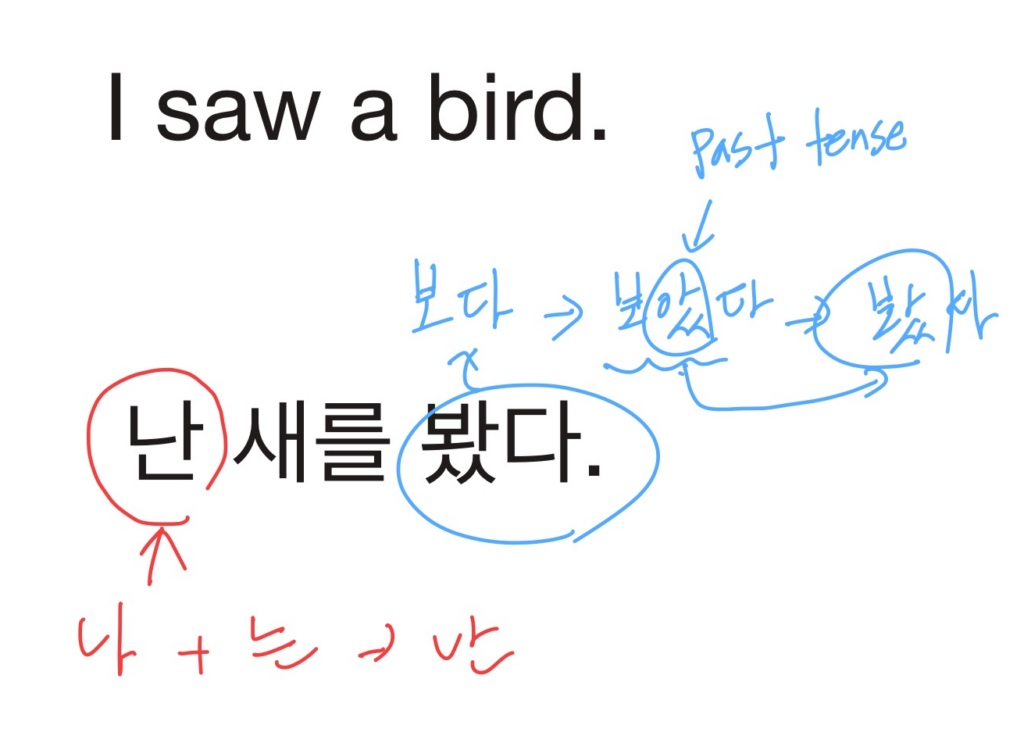
    난 할 거야 (“I will do it”) is a simple sentence that shows both types.


    In 난 할 거야, 거 is the phonologically reduced form of 것, which is a dependent noun. The 이야 attached to it comes from the predicate particle 이다 (dictionary form) in the Haera-che declarative form.

    Through this process, 것 and 이다 combine to form 것이야. Then, through the reduction, 것 is reduced to 거 and 이야 to 야. As a result, 것이야 is contracted to 거야.

    Meanwhile, 난 comes from the noun 나 and the particle 는. As a result, 나는 is contracted to 난.

    3. Contractions with 이다

    Grammar inside in "할 것이에요"

    We have already seen this structure in essay 5. The only difference is that the form conjugated from 이다 appeared as 이에요, not 이야.

    이에요 is the Haeyo-che declarative form, while 이야 is the Haera-che declarative form.
    For reference, 이다 behaves “80% like an adjective and 20% like a particle.” Because of this, it conjugates like a verb or adjective. It takes sentence-final endings, connective endings, and noun-modifying forms. 

    At the same time, it also has a particle-like nature, so it attaches to nouns, as in 것이야 → 거야. Another example is 뭐야, which is the contracted form of 무엇이야. 

    To sum up, 무엇 and the dependent noun 것 can each be reduced on their own to 뭐 and 거. Then 이다 is attached and conjugated. After that, further contraction takes place.

    4. Contractions with unconjugated particles

    Besides contractions involving the conjugated predicate particle 이다, there are also contractions in which 것 or 무엇 is followed by an unconjugated particle, such as 는 in 나는.

    Typical examples include 것+이, 것+은, and 것+을, as well as 무엇+이, 무엇+은, and 무엇+을. The table below shows the contractions that occur when 것 or 무엇 is followed by an unconjugated particle.
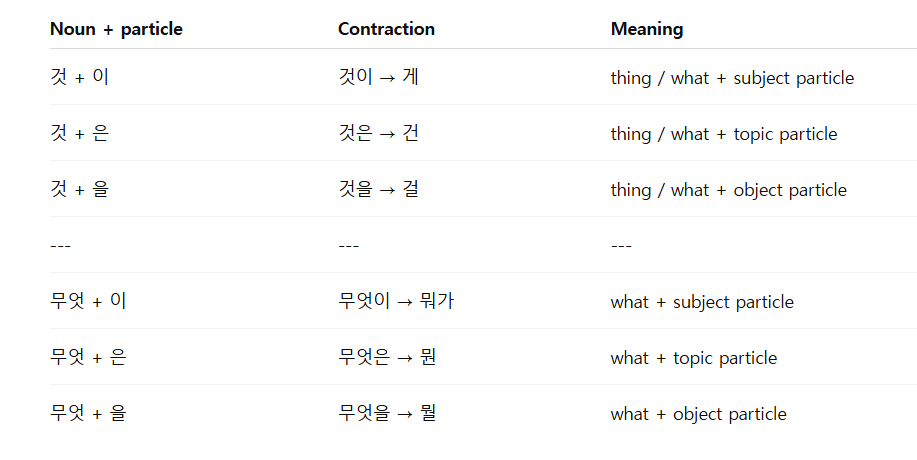
    Contraction (noun + particle)

    5. Contractions after conjugation

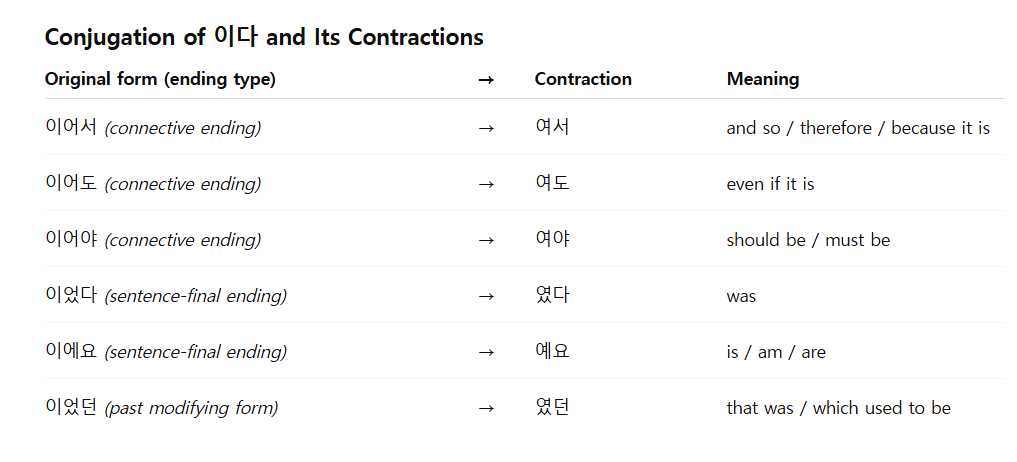
    The most representative case of contraction after conjugation involves the predicate particle 이다. When 이 is followed by -어, it contracts to 여. Examples are shown below.
    Why internalizing contractions saves time on TOPIK

    If these contractions are not clearly understood, they can easily cause confusion and slow learners down. Since TOPIK is timed, internalizing this process helps save time and lets learners focus on what actually matters on the exam.

  • Korean Conjugation vs. Contraction


    Korean Conjugation vs. Contraction


    We have been running for a long time. Now we slow down and catch our breath.
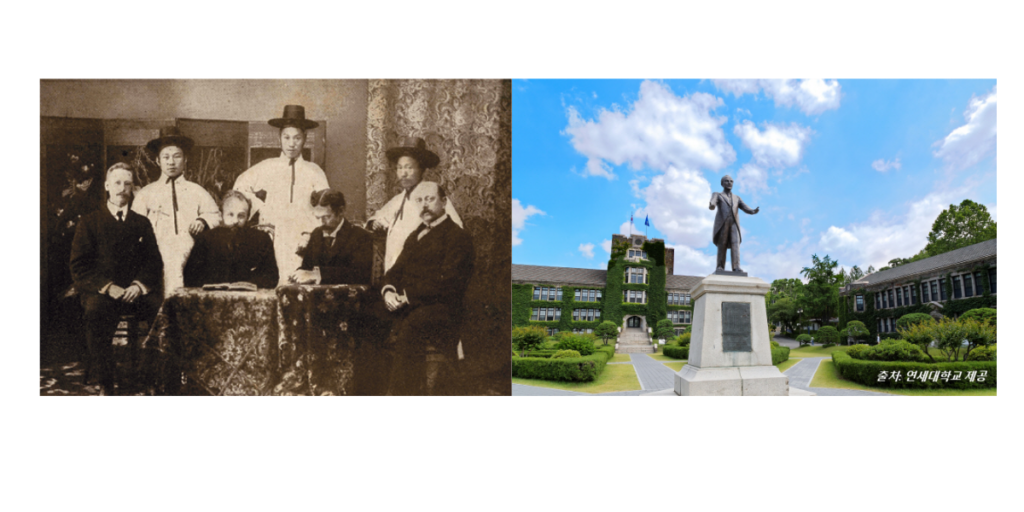
    I want to tell a story about Western missionaries who came to Joseon (the Korean dynasty before modern Korea) in the 19th century.

    This may interest you. They are like the ancestors of today’s Korean learners like you. They were early Korea experiencers who stepped onto the land of the Hermit Kingdom, Joseon.

    This is a short break for a historical moment.

    Not the land of morning calm

    Nineteenth-century Joseon was even more backward than what people today call a “banana republic.” 

    Recent comments by president Trump made that term controversial, but Joseon was far worse. In polite words, it was called the Hermit Nation or the Land of Morning Calm.
    In reality, it was nothing like that. The whole society lived in extreme poverty. Living conditions were harsh. Women lacked enough fabric for clothing. Their jackets became shorter and rose upward, often exposing their chests.
    One foreign scholar who traveled in Joseon wrote this.

    Many people lost all their teeth before the age of thirty. Some could not even pronounce words clearly because of that.


    Perhaps the clearest way to picture what that meant in everyday life is to look at a place many foreigners recognize today: Cheonggyecheon. 

    It is now a polished landmark in central Seoul, but its past tells a different story. The images below trace its transformation—1904, 1976, and 2023

    The photo on the left (1904) isn’t very clear image, so I’m attaching the 1976 one, too. It’s the same place.

    1852: two Kings, two futures

    Meiji Tenno and Gojong, the king of Joseon at the time, were both born in 1852. They were the same age. But their choices were completely different.

    One side went through the Meiji Restoration. It pulled the country into the center of the world. The other side held on to isolation until the end. Isolation (쇄국, 鎖國) meant exactly that. It meant locking the country with chains.

    Gojong wanted the people to remain a “hermit nation”. They did not want change. At that time, Joseon still served the Ming dynasty. 

    The Ming had been founded in 1368 and destroyed by the Qing in 1644. But Joseon believed the spirit of Ming did not die with the Ming. They believed it was still breathing on Joseon soil.

    Kim Ok-gyun and the enlightenment party

    A group emerged to break this feudal order. They were called the Enlightenment Party. One leading figure was Kim Ok-gyun. Through close exchange with Fukuzawa Yukichi, the father of Japan’s modernization, he was strongly influenced by his ideas. 

    Kim also came from a traditional elite family.

    When the Enlightenment movement failed, Kim Ok-gyun fled to Japan. Later, he was assassinated in Shanghai by an agent sent by Gojong.

    At that time, the Han River was not yet developed. Sandy beaches and ferry docks still remained. 

    His body was moved near Yanghwajin, one of those docks. It was publicly dismembered. His head was displayed at Yanghwajin with a white cloth. The cloth read, “Great traitor Kim Ok-gyun.”

    The remaining body parts were cut up and shown across the country. Foreign diplomats in Seoul strongly objected. But the execution went ahead. 

    The punishment followed the Great Ming Code. That law came from the Ming dynasty, which had collapsed 400 years ago. 

    Later, a Japanese man recovered Kim’s head. It was buried at a temple in Tokyo.

    At that time, ferry docks were the busiest places.

    They were where people passed most often. So his head was displayed in the most visible spot. (The picture below is Mapo-gu back then)

    Photos of the execution can still be found online. But they are not appropriate to show here. Instead, I refer to a photo published by Jiji Shinpo, which widely reported this incident at the time.

    Jeoldusan, the beheading mountain

    Behind the ferry dock where his head was displayed stood a cliff called Jamdubong. The name came from its shape. It looked like a silkworm lifting its head.

    About thirty years before Kim Ok-gyun was executed, this place saw something else. In the mid-19th century, a large Catholic persecution happened here. Thousands of Catholics were beheaded and died as martyrs.

    After that, the mountain changed its name. It became Jeoldusan, meaning “Beheading Mountain.”

    Facing this blood-named hill is a cemetery built much later. It is the Yanghwajin Foreign Missionary Cemetery. The graves of Western missionaries and believers its look directly toward Jeoldusan.

    Today, this place is the largest martyr site in Korea. In 1984, Pope John Paul II visited Korea and came here first. 

    Mother Teresa also came here to honor the martyrs. Even now, people come from all over the world to pay respect.

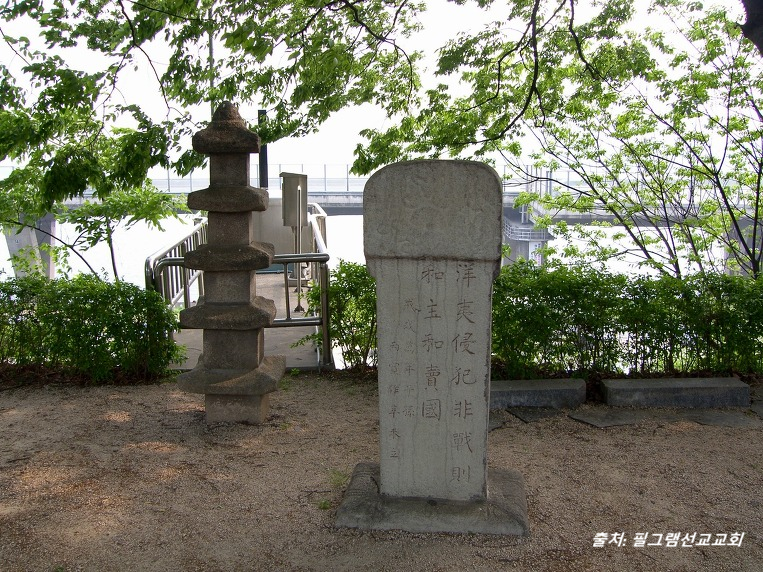
    At the same site, there is also an anti-foreign stone stele. It was erected during the executions of Catholics. 

    Its message says this. 

    If Western barbarians invade and we do not fight, that is calling for peace. Calling for peace means selling the country.


    When you read these words, the tension of that time becomes clear. So does the scale of the historical tragedy.

    The building in the photo is the new headquarters of YG Entertainment. It is a leading K-pop agency. 

    It produced global idols like BIGBANG and BLACKPINK. Through music production, it helped bring K-pop to the world. The martyrs executed here and Ok-gyun could not have imagined this future. 

    They could not have imagined that Yanghwajin, soaked with their blood, would later be linked to artists reaching two billion views worldwide. This contrast feels like a requiem for their spirits. Boombayah.

    If you are in Korea, or plan to visit, I personally recommend stopping by this place. You can feel one hundred years of change in a single spot.

    Back to grammar

    This has gone on a bit long. Now we return to the story of the missionaries (not the executed). In any case, Joseon was that kind of country.

    The French and German missionaries who came here were not tourists. They likely came with a mindset like Charles Darwin visiting the Galápagos. Or Clifford Geertz going to Bali. 

    They came out of cultural and anthropological curiosity.

    They studied Korean from a contrastive linguistics perspective. They tried to divide Korean parts of speech using their own native language systems. Because of this, confusion appears throughout their work. 

    Particles, not prepositions

    This was especially clear with French missionaries. They compared Korean particles to French prepositions like à Seoul (“Seoul에”) or avec Marie (“Marie와”). Based on this, they tried to understand Korean particles as postpositions.  

    Contraction, not declension

    They also looked at verb and adjective forms we discussed earlier. They tried to understand them as inflection, like eat–ate–eaten. 

    Soon, they noticed something important. In Korean, the stem does not change. Only the ending changes. At that point, they began to question their original framework.

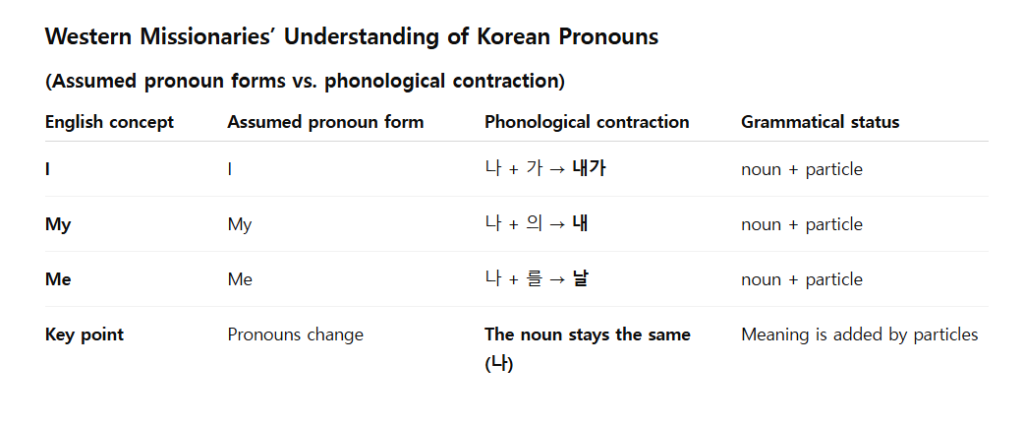
    They also used declension as their frame. They looked at English I / my / me, German Ich / Meiner / Mir / Mich, and French Je / Me / Moi. They understood Korean 나 → 내가(I) / 내(MY) / 날(ME) in the same way.

    In other words, they confused two different things. They treated phonological contraction(or reduction) as declension.They thought they were the same process. If you are beginners, you are probably not very different from them.

    Korean pronouns

    But 내가, 내, and 날 are all built the same way. They are 나 + 가, 나 + 의, and 나 + 를. This is not postposition or declension. It is a particle. What Westerners thought was declension was not declension. 

    It was a sound change caused by unconjugated words meeting each other.

    That is why Korean language programs (Like Sungkyun Language Institute) teach these changes separately. They are called palatalization, liaison, and nasalization. 

    In Korean, these sound changes are grammatically allowed. In the end, you must understand this kind of phonological contraction. Only then can you clearly separate conjugated words from unconjugated words.

    Two types of contraction

    There are two main types of contraction in Korean. One happens when unconjugated words meet each other. It usually appears when a noun combines with a particle.

    The other happens after conjugation. As mentioned in the first essay of this blog, a good example is the conjugation of 먹다 (to eat). 먹-으시-었-어요? Becomes 먹으셨어요?.

    Missionary, not mercenary

    When I briefly wrote about missionaries, one idea stayed in my mind. Jeff Bezos made this contrast famous: Missionary vs Mercenary. I hope the materials I have made, and will keep making, move you a little closer to the missionary side—curious, patient, and committed to the long game, even when progress feels slow. 

    Studying Korean can feel messy at times. You may start with clear reasons. But along the way, it is easy to lose direction. And slowly, you drift toward the mercenary side—impatient, distracted, and easily discouraged. 

    There is one more interesting fact. Today, South Korea records at the top 3 missionary-sending countries in the world with America. The missionaries who first stepped onto Joseon land in the 19th century could not have imagined this scene. Not even once.    

    What you learned today:

    • There are two types of contraction in Korean. This contraction helps you distinguish unconjugated words from conjugated words. Along the way, you also saw a small part of Korean history.


    In the next essay, I will look at common cases of contraction. These cases help distinguish conjugated words from unconjugated words. This section went a bit long. It covered history as well as grammar. We will meet again in the next essay. It will likely be the final one.

  • Korean Conjugation in Sentences and Paragraphs


    Korean Conjugation in Sentences and Paragraphs 


    Jang Dong-hyuk writes an essay during a hunger strike. The tent behind him stands in the Rotunda Hall of the National Assembly, where he is holding a sit-in protest.

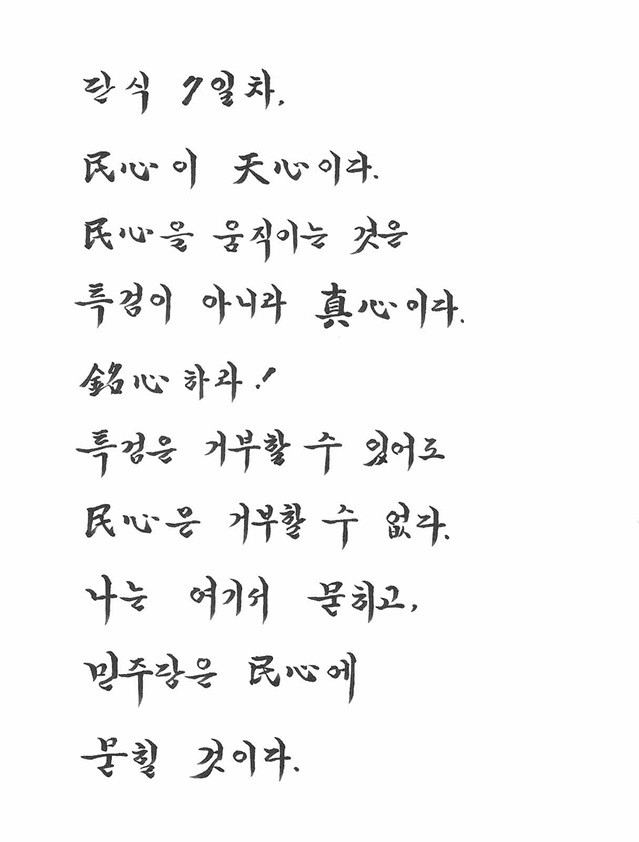
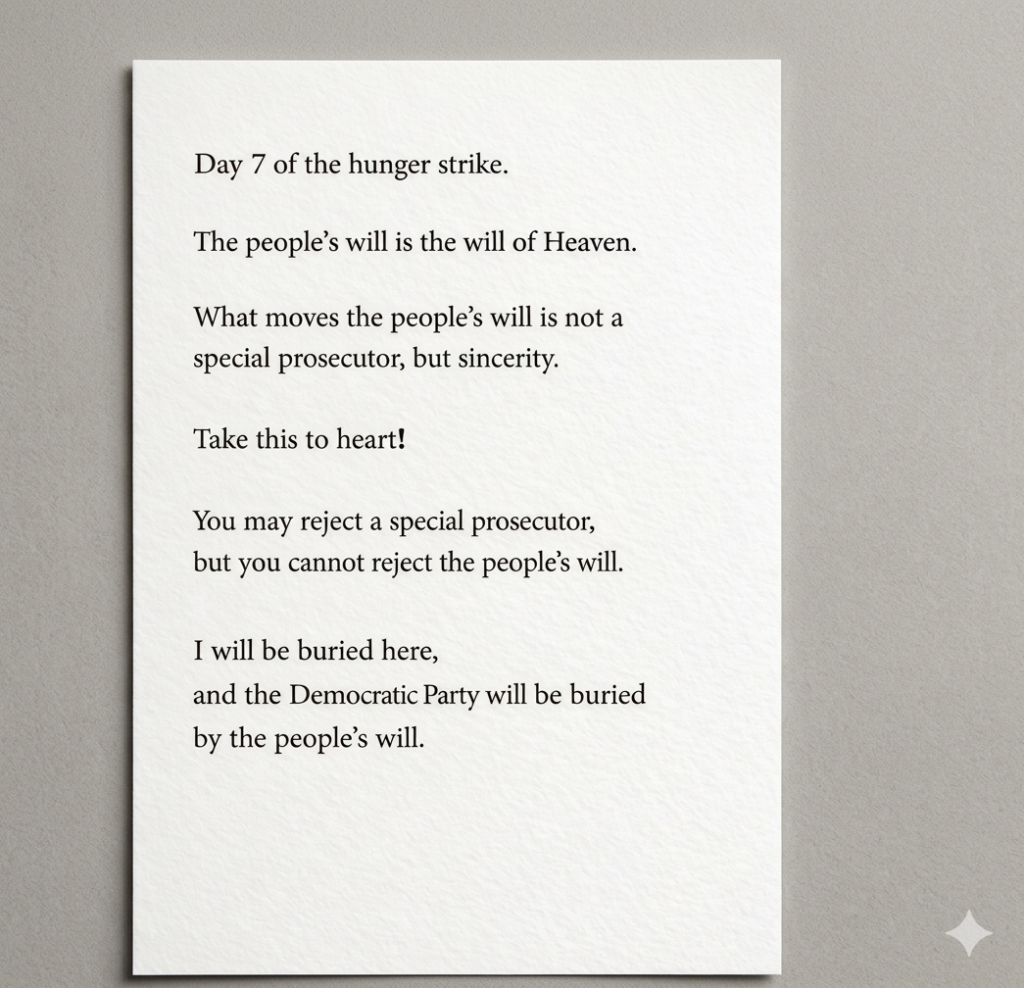
    Here is Jang’s Facebook post, written on day 7 of that hunger strike: 

    For readers who want to compare it with English, I included an English translation as well. I received help from Gemini for generating the image.

    Follow the steps and do it the same way

    It is a striking and rhetorical political statement.

    Separate from its political message, the key question is whether we apply what we have learned so far.

    I will show you how I apply what we have learned to sentences. First, I identify which words are conjugated and which are not. Then, I classify the conjugated words by the three major roles of conjugation. That is all.

    You can use the same method for any other sentences you encounter.

    For readability, I will use different colors as follows. If my handwriting is hard to read, please understand.   

    • Conjugation 1: Sentence-final ending (green color)

    The “-다.” is mostly used for stating facts, organizing thoughts, or explaining principles rather than directly speaking to someone (like -아/어요). It is commonly found in diaries, news headlines, academic writing, philosophy, or monologue.

    In Jang’s post, before “명심하라,” he consistently uses the “-다.” to state truths and principles.

    Then suddenly, he shifts to: “명심하라!”

    This is the Harae-che imperative form. Unlike the previous sentences, it directly addresses the Democratic Party and commands them to “take this to heart!”

    Without understanding -che, it is difficult to notice this subtle but important tone shift.

    You can do it the same way I do

    It may seem difficult at first. But learners who follow along with me will gain confidence that this method is very effective. It is the fastest way to study Korean. 

    Studying Korean can feel like solving Sudoku. That intuition is accurate. Learning Korean works much like a logic exercise preventing dementia.   

    The key point is this. You must fully understand the conjugations. Then you clearly separate conjugated words from unconjugated ones. 

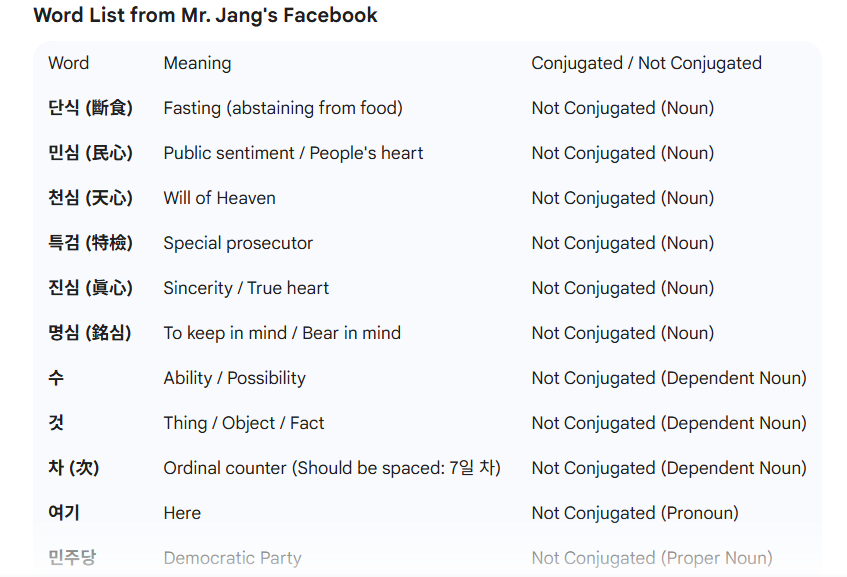
    I use the text written above by Jang as an example. I include word list for learners who want to study which words are conjugated and which are not:

    Now you know the right way to study Korean. By following this approach, it helps you to develop the ability to read and write. 

    More importantly, this method allows you to internalize words and learn them by heart. By contrast, words in a word list exist only for memorization. They are dead pieces of wood.

  • Korean Noun-Modifying Forms of Verbs and Adjectives


    Korean Noun-Modifying Forms of Verbs and Adjectives


    Korean learners often have this question. In English, structures like don’t do it, don’t go, or don’t eat are simple: you only need do + not.

    Korean looks complex, but not because it has too many forms. It feels complex because the core structure of conjugation has not been clearly separated yet.

    Once you are familiar with that structure, you can approach Korean in a word-order-centered way—much like English, which you may already be comfortable with.

    Let’s begin

    Compare future tense: -겠- vs. -(으)ㄹ 것

    Earlier, we turned an action into a state using the connective ending -고, as in “먹고 있다.” Here, 있다 is used as an adjective. Its dictionary form already functions as the present tense.

    So if you want to move this state into the future, you attach the future ending -겠- to the adjective 있다. The result is 먹고 있겠다.

    However, if you use -겠- to make the future, it often sounds more definite than a simple future, like we saw with 먹는다. In English, its nuance is closer to must than am going to or will.

    In Korean, auxiliary-like future meanings such as “am going to”, “will”, or “can” are often handled differently. 

    Korean combines a tense-marked noun-modifying form with a dependent noun. A representative example is (먹을) 거예요 (will), which you may learn very starting point.

    It looks very simple on the surface. But many precise grammar pieces are hidden inside this short form.

    In this essay, we will cover the second type with [할 것이다 (will do)]. 

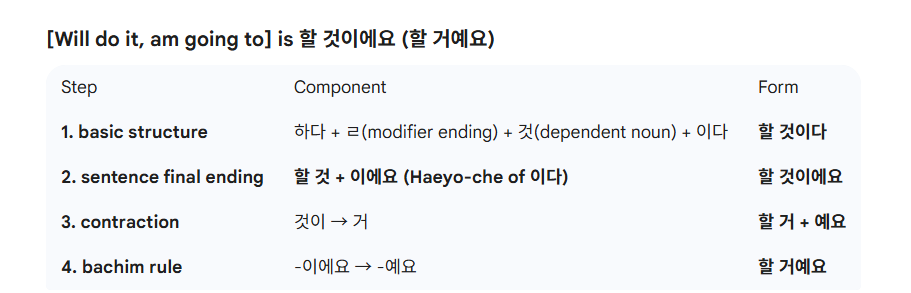
    For now, just focus on the future modifying form “할” of the verb 하다 (to do)—that is, “하-” + “-(으)ㄹ” and the dependent noun “것”,which “할” modifies. This can be illustrated as follows:

    grammar of 것이다, 것이에요


    It (할 것이에요) becomes 할 거예요 by following:

    할 것이에요 structure to 할 거예요


    Dependent nouns: key features you must remember

    Dependent nouns are important for three reasons.

    1. They must always be modified by a modifier.
    2. They can be modified by a verbs’ and adjectives’ noun-modifying form (modifying form, for short) that carries tense.
    3. Because they are nouns, they can take particles that add meanings that English often expresses with adverbs.
    conjugation and tense


    Here is a list of dependent nouns:

    dependent noun


    There may seem to be many examples. But they all come from the same grammar system. So if you understand the basics well, you can accept the rest without much trouble. 

    In Korean, these dependent nouns are used very often in daily conversation. If you do not study them separately, having natural conversations becomes quite difficult. 

    The tense-carrying modifier system

    A modifier is one of the nine parts of speech in Korean. Its basic role is to modify a noun. Modifiers have two main types. One is the modifier—part of speech. The other is the verbs’ and adjectives’ noun-modifying form—conjugation. 

    The second type is special because it carries tense information. So when a verb or adjective conjugates and modifies a noun, especially a dependent noun, the tense information naturally combines with that noun.

    conjugation, dependent noun and 할 것이다


    All the examples in the table above come from 할 것. You might feel confused because “will” doesn’t appear in the English Equivalent column. However, if you look closely, you will notice that every English phrase listed there still carries a future meaning. 

    Is it complicated? It was complicated for me, too, when I was learning English. I often thought,

    “In Korean, it’s  so convenient—you can just attach things after 할 것. Why does English need so many words?” 

    When we learn languages, we can understand each other. That’s a good interactive point.

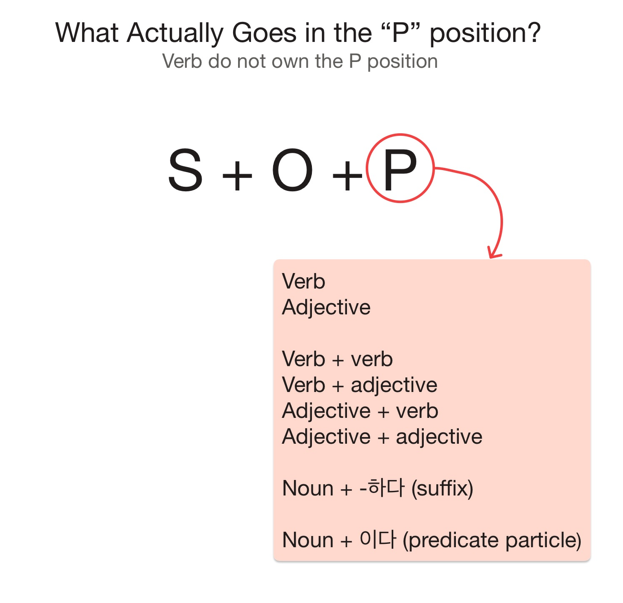
    A V/Adj’s modifying form modifies a dependent noun. Once this structure is formed, after that, what can appear in the P position – that is, verbs and adjectives – conjugate again.

    They either take a connective ending or a modifying form, or they close the sentence with a sentence-final ending, which we learned first.

    Here are examples:

    • 할 것이고 (이다 → connective ending)
    • 할 것이에요 (이다 → sentence-final ending)
    • 할 수 있을 (있다 → noun-modifying form) 것 같아요 (같다 → sentence-final ending)


    이다: 80% adjective, 20% particle, thus conjugates and attaches

    Now the last thing to study among what can appear in the P position is 이다 (is)—the green highlighted one above the table. 이다 is like Shohei Ohtani. You cannot define him as only a pitcher. You cannot define him as only a hitter.

    From here, I will examine 이다 in detail.


    이다 is a particle. And particles are unconjugated words—normally. But 이다 is an exception.

    이다 is a conjugated word. Here, “conjugated” means 이다 can be used like verbs and adjectives. 

    Its dictionary form already carries present tense meaning. So about 80% of its nature is like an adjective. The remaining 20% has particle-like properties.

    Because of the remaining 20%, a particle (이다) can attach to a noun without a space. The key point is that [noun + particle] does not create a new word.

    Thus, 것이다 is not a new word.

    So, when 이다 attaches after a noun, the part of speech does not change.

    The core is still a noun. 

    That’s why 이다 can also come after a verbs’ and adjectives’ noun-modifying form. Think about 할 (future modifying form) 것이다 (noun).  This is the crucial difference from another P-position item, [noun + 하다 (suffix)].

    Why modifying forms cannot come before -하다 verbs

    With the suffix -하다, -하다 combines with a noun and creates a new word. The new word becomes a verb. 

    So the part of speech changes. Because of that, a verbs’ and adjectives’ noun-modifying form cannot come in front of that “new verb”. 

    It may sound hard in understanding. But with examples, it becomes clear. 

    compare of 이다 and 하다


    Because 이다 is 80% like an adjective, it can conjugate. I already explained the three different types of conjugation. So I will skip the explanation here. I will replace it with tables.

    이다's sentence-final ending
    이다's connective endings
    이다's modifying form


    Recommended tool: build your conjugation in EdrawMind

    In Korean, anything that can appear in the P position—verbs and adjectives—conjugates. That is the rule.

    So for conjugated words, I recommend a mind map rather than flashcards.

    Start with just 10 conjugated words from their dictionary forms. That’s enough to see the core patterns and get an idea for the Korean’s operating principle. 

    Some learners use flashcards for everything without making this distinction, but I don’t recommend that for conjugated words. Memorizing conjugated forms one by one usually doesn’t help you produce sentences, so it can be inefficient.   

    If a method does not help you build sentences on your own, it is not the best use of your time.

    Personally, I recommend EdrawMind (Mind Map Tool), and it can be helpful to use it alongside Gemini. The usage is like:

    Edrawmind


    Space issue: 수 있다 vs. 것이다

    “할 수 있다” (can do) is formed by the same principle. However, 있다 (exist) is not a particle, so it is written with a space.

    Because of this, different particles can attach after the dependent noun 수. This allows the meaning to expand. 

    By contrast, in 것이다, 이다 is tightly attached to 것. It leaves no space in between. So if you want to attach another particle after 것, 이다 must be dropped.

    grammar of 할 수 있다


    Grammar in the wild

    So far, we have organized how conjugated words work. If you have learned it, you should now try using it.


    I explained only two grammar structures—the two types we have learned. Now let us see how far we can go. 

    You will meet words you do not know. This is inevitable. But now you can tell whether a word conjugates (so mind map helps) or whether you simply need to memorize it (flashcards work better), because its form doesn’t change. 

    Once you make that distinction, Korean sentences stop feeling heavy.


    In January 2026, Jang Dong-hyuk, the party leader of the People Power Party, began a hunger strike.

    He said it was to push through a special law to investigate bribery and illegal donations in exchange for party nominations.

    In the next essay, we will look at a Facebook post he wrote on day 7 of that hunger strike. Through this text, we will see how the grammar structures you just learned work in real sentences.

    It will be interesting.

    Let’s go.

  • Korean Connective Endings: How They Work


    Korean Connective Endings: How They Work


    I personally do not like a top-down writing style. Once I know the ending first, the interest of the text fades fast.

    That style also feels like an AI summary with no rhythm. It cannot carry the subtle emphasis hidden between the lines. But this essay will be different. 

    Through this essay, and likely the next one, you will understand what kinds of parts can appear in the P position in Korean. You will also gain the ability to build Korean sentences by yourself.

    SOP, verbs and adjective can come at "V" spot.


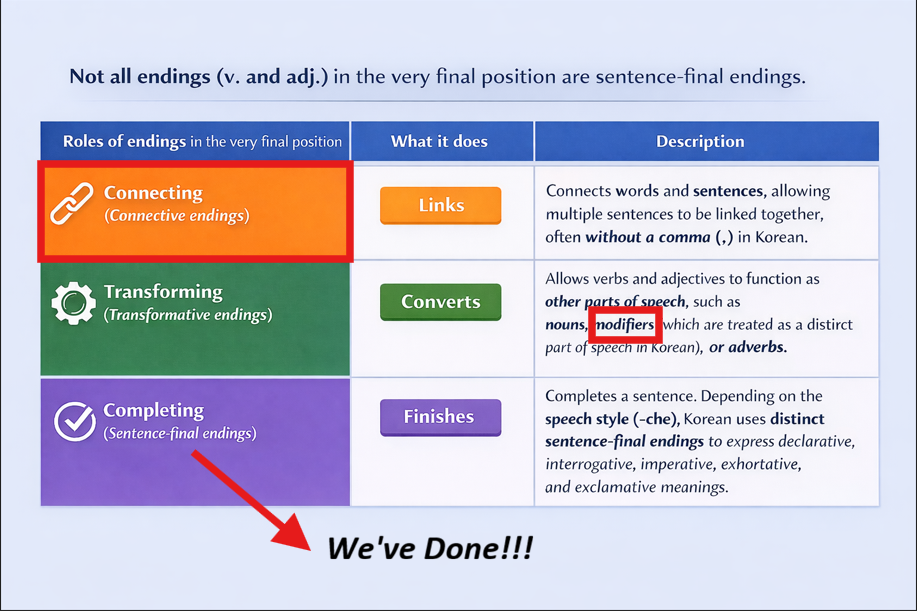
    So far, we have seen that verbs and adjectives are conjugated with endings. Through different speech styles (-che), they close a sentence using sentence-final endings. 

    But the position is not enough

    As seen above, these conjugated verbs and adjectives sit in the predicate position of the sentence. If Korean were a word-order-based language, this would be everything. There would be nothing more to explain.

    And if that were true, then knowing that verbs and adjectives conjugate in the predicate position would already be enough. You should be able to make Korean sentences on your own. But that is not how it works in reality.

    And likely, the reason you still cannot make sentences yourself is this: The conjugated words that can appear in the predicate position often leave their position. They show up across the sentence instead. (Remember that conjugation means the endings attached to the stem of verbs and adjectives)

    Korean connnective endings and modifiers


    This kind of conjugation works in two main types, as seen above.

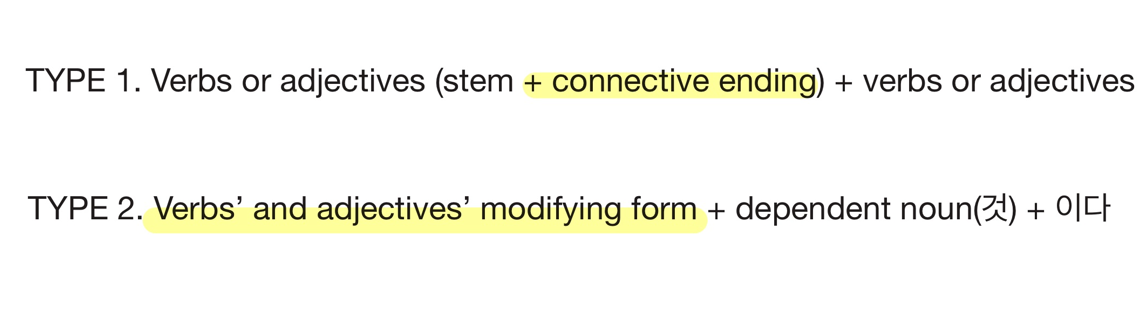
    • Type 1: Connective endings attach to the stem of verbs and adjectives.
    • Type 2: transformative endings attach and turn verbs and adjectives into modifiers.


    Type 2: how Korean builds “will” and “can”

    Here, the meaning of the second type is this. Verbs and adjectives gain the ability to modify the noun that follows them. The key point is this. 

    Unlike English, the noun-modifying form (verbs and adjectives) created by these transformative endings carries tense information while modifying the noun. The most important point is this.

    These conjugated verbs and adjectives can modify all nouns. But they are especially used to modify dependent nouns. A dependent noun cannot stand on its own without a modifier.

    Typical examples are “것”, “수”, “때”, “데”.

    English has no grammatical category that directly matches Korean dependent nouns. When a noun-modifying form modifies a dependent noun, Korean gains functions that match English auxiliary verbs. 

    For example, “will do” becomes “할 것”, and “can do” becomes “할 수”. In addition, dependent nouns can take over the role of English conjunctions, such as 때 (when) or 데 (where).

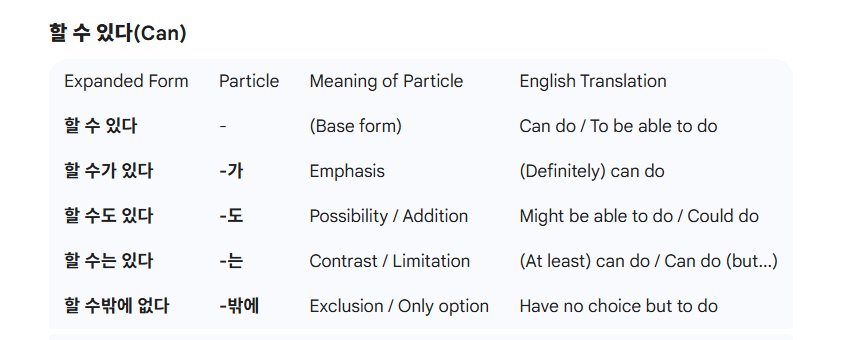
    할 수 있다 (can in Korean)


    Further, a particle can attach after a dependent noun. (A particle is an unconjugated word, so it is not spaced.) Because of this, Korean handles fine meaning differences inside one system.

    In English, you must add an adverb after an auxiliary, like “can probably“. Or you must place adverbs like “only” or “even” before conjunctions such as when. Korean integrates all of this within a single structure.

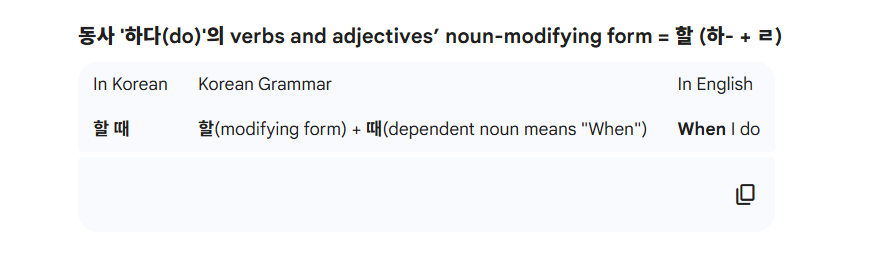
    하 + ㄹ


    The example above is built using “때”, a dependent noun that carries the meaning of when.

    Because 것, 수, 때, 데 are nouns by nature, they are dependent nouns. They receive modification from a noun-modifying form, and form a noun phrase.

    That noun phrase can serve different sentence elements, such as subject or object. 

    I have only touched briefly on the second type here. I will explain it in more detail after covering the first type.

    The grammatical structures of the first and second types are as follows:


    The first type and the second type can be used separately. They can also appear together in a single sentence.

    Because of this, it is more effective to learn their features one by one first.
    Now, let us look at the first type.

    Type 1: connective endings: linking situations

    In the first type, you first need to know what a connecting ending does, and what it connects. 

    A connecting ending connects “situations”. The situations it connects fall into three main ways:

    • Independent situations: equal listing or contrast (and, but)
    • Dependent situations: cause, condition, or background (because, if, so)
    • Time-ordered situations: the timing or flow of events (as soon as, after, while)


    This linking of situations happens in two grammatical ways:

    1. A way that links one sentence to another sentence.
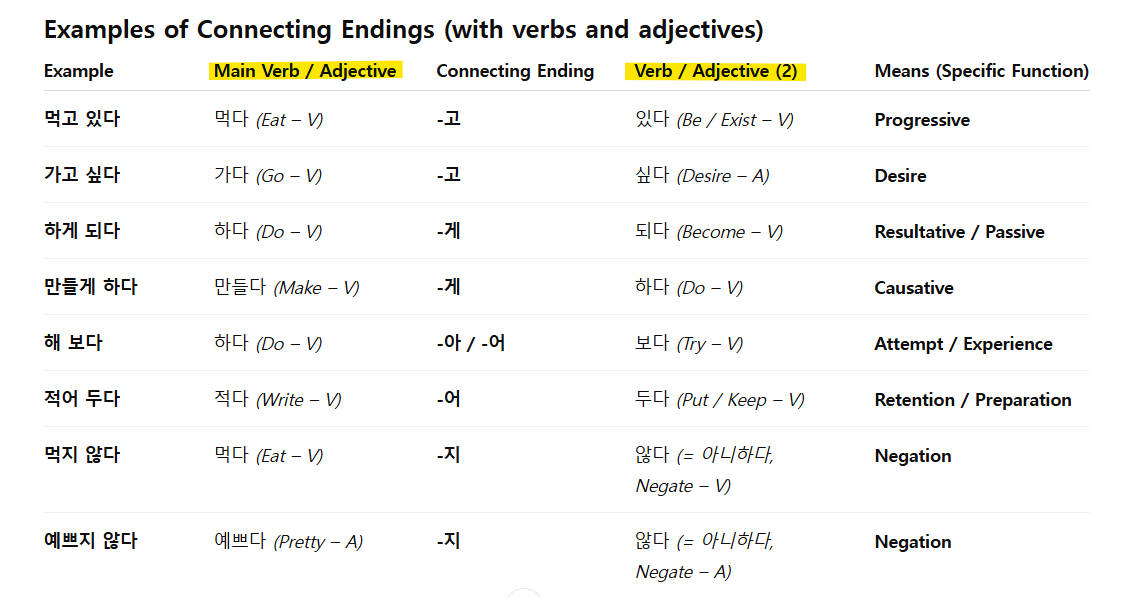
    2. A way where a connecting ending attaches to a verb or adjective and leads into the next verb or adjective.


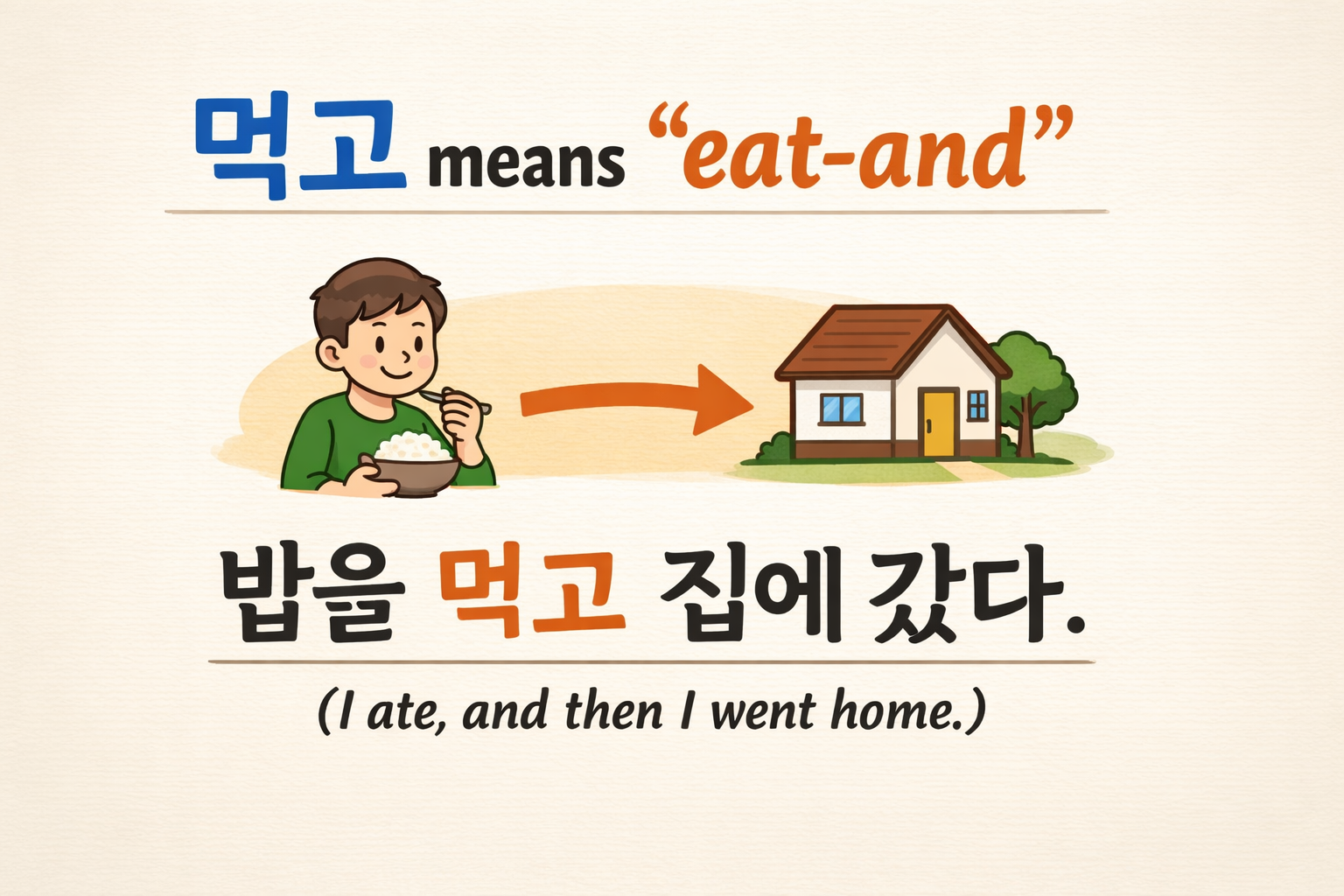
    You link situations by choosing the connecting endings that fit each situation. Here, I will use “-고”, an ending that means and, as an example. I will show its use through “먹고”, the conjugated form of the verb 먹다.

    The first way is very easy. It is similar to English and. So I will replace the explanation with examples below.


    갔다 (went) is a conjugated form of the verb 가다. It uses -았-, the past-tense, so 가다 + -았- becomes 가았다, and then it contracts to 갔다.

    In Korean, contractions fall into two broad types. One type comes from contracting unconjugated words—nouns + particles. The other type happens after conjugation. 갔다 is the second type of the contractions.

    It would be better if you understood the whole sentence. But here, the key point is not the full meaning of the sentence. So I will skip a detailed explanation.

    The second way

    The second way is the most important. This is not just a matter of choosing a grammar form. It is because Korean ways of thinking are directly reflected in the system of grammar. But if you have followed my writing closely so far, you can likely predict this. You can expect that I will be able to help you reach full understanding.

    In the second way, “-고” plays a role similar to English to and and when linking verbs and adjectives. 

    However, some words that Korean treats as adjectives are the verbs in English.

    Like this: want (verb) to eat (verb) = 먹고 (verb) 싶다 (adjective)

    This difference shows up clearly in the idea of “want.”The Korean native word 싶다, which corresponds to English want, is not a verb; It is an adjective.

    Because it expresses a state of wanting, 싶다 cannot stand alone; it needs content—typically a verb phrase, as in V-고 싶다. This shows how Korean treats desire or intention. It is not seen as an action, but as a state.

    So Korean description does not stop at — an action happens. It is also organized to show how that action is understood as a state. In other words, it tends to mark the aspect of the action as well—such as ongoingness, completion, attempt, or guessing.

    English organizes meaning around actions. Korean describes meaning in a more state-centered way. In this sense, adjectives are predicates in Korean.

    If you want to express the “state of wanting” as an action in Korean, there are two common options.

    • 원(願)하다: This is a Sino-Korean verb. It combines the character 願 (want) with the verb 하다 (do) to form 원하다. In Korean, a native word often exists as an adjective.
      Then a Sino-Korean word with a similar meaning combines with –하다 (suffix) to form a verb.
    • 싶어하다: This turns the adjective 싶다 into an action-like expression.
      It attaches the connecting ending -어 to 싶다 (싶어), and then combines it with the 하다, forming 싶어하다. Grammar books often explain this as the –“어 하다”. It is especially common when describing someone else’s desire, because from the speaker’s point of view it can sound more natural to describe the person’s wanting as an action rather than inner state.

    Two more are: 있다 and 말다

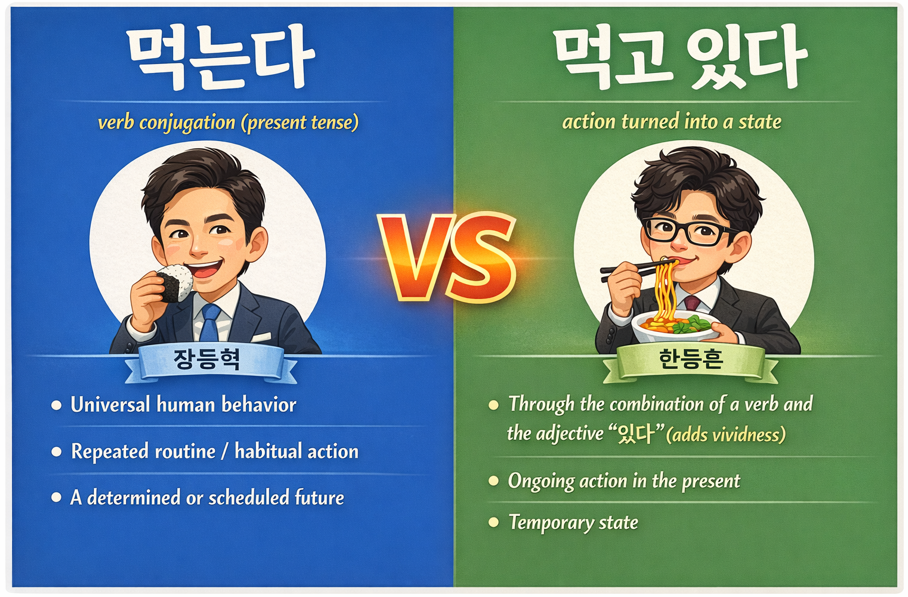
    As explained in the earlier essay, 있다 is also an adjective. The adjective 있다 expresses a state. This includes existence, possession, and an abstract condition being in place. The contrast below shows the nuance clearly. 먹는다 shows an action only. 먹고 있다 shows action plus state. 

    -고 있다


    Another example is 말다. It appears in expressions like “하지 마.” 말다 is a verb that means stop. Because it is not an adjective, it can take imperative form, 마. 말다 can conjugate with the sentence-final ending -아 to become 말아. -아 is the hae-che imperative form.

    In 말아, the ㄹ drop happens, so it becomes 마아. Then 마아 contracts to 마. Using the connective ending -지, you can form expressions like the followings.

    Korean grammar: 하지 마


    It may look hard at first. But once you group it into a pattern, what you need to study next becomes clear. For learners who want more, I add a few examples below. I will skip detailed explanations. 

    All kinds of connective endings in Korean


    A spoken shortcut that changes the meaning:
    -지 아니하다 → -지 않다 → -잖아

    More helpful for learners, -지(connective ending) 아니하다: This part is a very useful tip for real-life speech.

    -지 아니하다 contracts to “-지 않다”. This expression can contract further to “-잖아”.
    In this process, both the form and the meaning change.

    Contraction 1: 밥 먹었지 않아?

    • This corresponds to “Didn’t you eat?”: Like in English, the speaker is checking a fact that the listener already knows, or is expected to know.


    Contraction 2: 밥 먹었잖아!

    • This corresponds to“You already ate.”: The question’s meaning disappears. Instead, it becomes an emphasis on a shared fact between speaker and listener.


    What you learned today:

    • things that can appear in the P-position


    So far, we have focused on conjugation where connective endings attach to the stem of verbs and adjectives. In the next essay, we will cover the second type. It is conjugation where transformative endings attach and turn verbs and adjectives into modifiers. 

  • Korean Is Not an SOV Language


    Korean Is Not an SOV Language


    Korean is usually called an SOV language. That label is close, but wrong in a way that matters.

    Verbs and adjectives sit in the same place in Korean. Both come at the end of a sentence, and both conjugate there. “V” only covers half of that. 

    Borrow the English label, and you carry that error from your very first lesson.

    Here is the question it creates.

    Is Korean SOV language?


    I will use the verb 먹다 and the adjective 예쁘다 as the main examples. Both end
    in 다. That ending is the Haera-che declarative form, not a part-of-speech marker.


    Why “SOV” is a learning trap

    When people learn Korean, they often use English as the reference point. English is a global standard. As a result, many explanations teach Korean by mapping it onto the English (SVO) frame, and they often label Korean as an SOV language. 

    There is something odd here.

    S (subject) and O (object) are sentence elements. But V (verb) is a part of speech.

    In other words, this notation mixes concepts from different categories in one symbol system. If S and O are labels for sentence elements, then the matching label should not be V. It should be P, predicate.

    Why English uses “V”

    In English, people use V (verb) because the predicate is always built around a verb.

    Also, in English, an adjective cannot serve as the predicate by itself. A verb, usually the verb be, must function as the main predicate. 

    Because of this structural feature, a convention was formed. Instead of marking the predicate as P, people mark it directly as V. This reduces conceptual confusion within the English system.

    So Korean learners who are used to English naturally think “V” means “verb.” Then they see an adjective like 예쁘다 in the “V” position. This makes them confused. They think, “Why is an adjective in the V slot?”

    Korean is SOP: what can fill “P”

    In fact, Korean is not an SOV language. It is an SOP language.

    In the next essay, we look more closely at what can appear in this “P” position. As I have said, both verbs and adjectives can come in the P position. There are also a few more things we need to note. 

    Everything that appears in this position can be conjugated.

    The goal of this essay is to give you a predictable way to guess what can fill the P position. This is the most important point. This is the key point in Korean grammar.

    Verbs vs. adjectives in Korean

    Now we can talk about how Korean distinguishes verbs and adjectives.


    If it’s hard to see, double-click the image to zoom in.

    As shown in essay 2, the left table shows the sentence-final endings of 먹다 by speech style (-che) and speech form. The table on the right is built in the same way, using the adjective 예쁘다.

    The difference between the two tables shows the difference between verbs and adjectives. 먹다 (dictionary form) does not appear directly in any -che. If a form is not in the table, it means 먹다 cannot be used by itself in a sentence.

    In contrast, the adjective 예쁘다 (the highlighted one) can be used in a sentence in its base form (dictionary form).

    The verb 먹다 describes an action. So when it is used in a sentence, it must show tense, meaning when the action happens. Because of this, the base form (dictionary form) 먹다 cannot be used as it is. A tense ending must be added. For example: “먹는다” for present, “먹었다” for past, and “먹겠다” for future.

    Adjectives work differently. An adjective already contains the meaning of state and “present time“.

    So in the present tense, the base form stays the same: 예쁘다. In the past tense, it becomes 예뻤다—예쁘 + “었” → 예뻤. To express future meaning, it becomes “예쁘겠다”—예쁘 + “겠“.

    There is one more important difference. Adjectives cannot use the imperative or exhortative form among speech forms.

    This table makes the difference clear: 

    Dictonary form of 먹다 and 예쁘다


    Exception: 있다 as both verb and adjective

    There are exceptions. Some words have the same base form on the surface, but their meaning makes them act like a verb or like an adjective.

    “있다” is one example.

    When 있다 means “stay,” it works as a verb. When it means “being there”, “having something”, or “staying in a state,” it works as an adjective.

    As a verb, 있다 can take a present ending like 있는다. As an adjective, it cannot. The present form of adjectival 있다 is the same as its dictionary form—있다.


    What you learned today:

    • There is a trap in the “SOV” label: it mixes sentence elements (S, O) with a part of speech (V).
    • Verbs need a tense ending to be used in a sentence. Adjectives can appear in the present in their base form, and they cannot use imperative or exhortative forms.

    In the next essay, we will look at what can appear in the predicate (P) position in Korean grammar.

  • Sentence-final endings (-che)


    Sentence-Final Endings (-che)


    Y-combinator


    Paul Graham, the co-founder of Y Combinator, defines pain like this: “The pain is a memory as soon as you feel it.” Building the basics, especially grammar, is hard. 

    It is not fun. It takes sustained effort. But that pain fades quickly. In the end, it remains only as a memory.

    Why study Korean


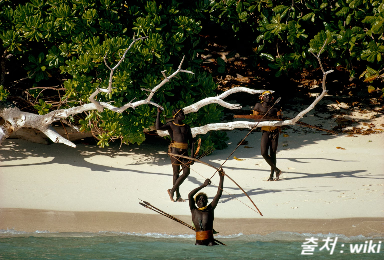
    If this alone does not bring comfort, imagine a near future where you go to North Korea and speak directly with children there. After North Sentinel Island, it is one of the most closed places on Earth, yet you can connect with its children through language.

    That is a striking idea. Personally, I expect this to happen within 10 to 15 years. At this point, the motivation should be sufficient. So let us continue.

    To repeat this again, in Korean, the only conjugated words are verbs and adjectives, and these conjugated words change through conjugations (the meaning part stays fixed). Conjugations include tense and subject honorifics. And the ending at the very end of a conjugated word has three main roles.

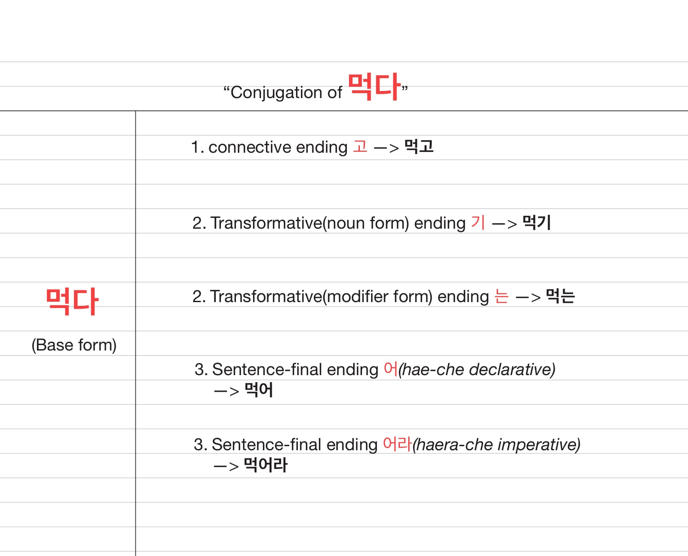
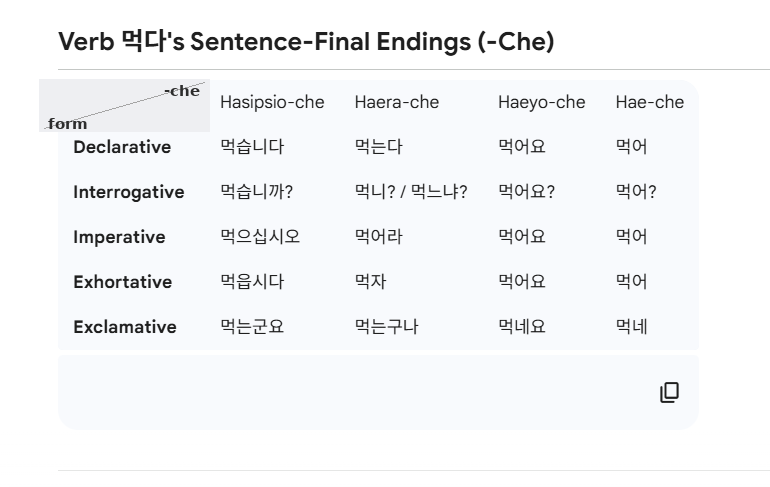
    Sentence-final endings with 먹다

    Let’s look at how the very last ending changes, using the verb “먹다.”

    For now, you only need to focus on the sentence-final ending. The other endings, like connective endings and transformative endings (especially modifying form), will be covered in another essay.

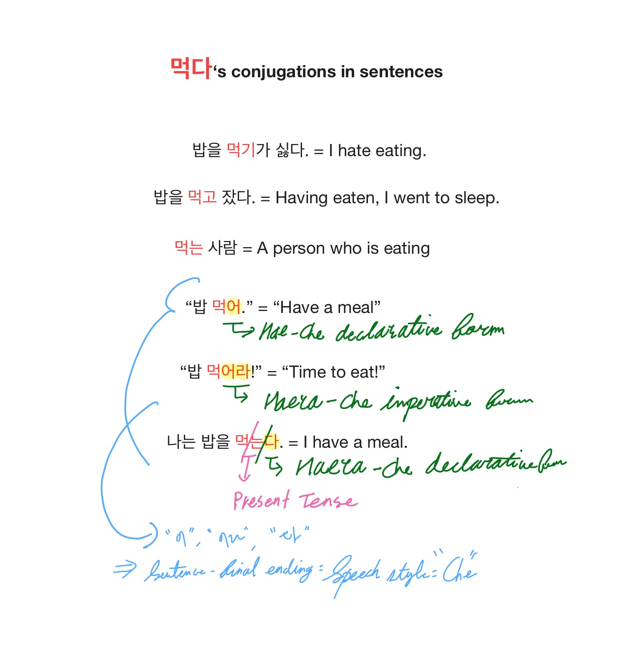
    I’ll first show the full conjugation of the base form “먹다.” Then I’ll show how those conjugated forms are used in sentences. 

    My handwriting can be messy, so I’ll use my Galaxy Tab as much as possible—but please understand if it isn’t always neat.

    Conjugation of 먹다
    먹다 in sentences


    We use different sentence-final endings depending on the speech style (-che) and the speech form, like declarative or interrogative. 

    In this process, the meaning part, “먹,” stays fixed.

    There are six types of -che, based on the verb “하다” (to do). These six -ches reflect the speaker’s attitude, and each one includes the five speech forms. In the examples below, I show only the four most commonly used -che.

    You can find “먹어,” “먹어라,” and “먹는다” below the table


    Regular vs. irregular conjugation and contraction

    As I keep saying, when endings change, we call it conjugation. This conjugation is a combination of a fixed stem and the letters added after it, which are the endings.

    There are three regular conjugation patterns and nine irregular ones. With the verb “먹다,” the meaning part (stem), “먹,” does not change during conjugation. That is why “먹다” is the easiest verb to explain.

    The other regular patterns are ㄹ drop and ㅡ drop. These three are called regular because the drops happen in fixed conditions. Most of these changes developed to make pronunciation easier. 

    If this feels confusing, think of Saladin, the great Muslim leader of the 12th century. He fought Richard the Lionheart during the Crusades. His full name was Ṣalāḥ ad-Dīn, but in English it became Saladin — the sounds were simplified for easier pronunciation. 

    A similar kind of simplification happens in Korean, too. You can think of these patterns like formulas, and we’ll organize them later.

    In the table above, the Hae-che declarative form of “먹다” has the vowel “ㅓ,” so it becomes “먹어.”

    The verb “가다,” which means “to go,” has the vowel “ㅏ,” so the ending “아” is added. This gives us “가아.” However, during actual use, “가아” is shortened to “가” to make pronunciation easier.

     In Korean, there are two main types of contraction. One is simple contraction. The other is contraction after conjugation.

    For example, in “먹으셨어요” on the main page, “셨” comes from [시 + 었] after verb conjugation. Contraction after conjugation can only happen with verbs and adjectives, because conjugation must come first.

    This was one of the hardest parts for Western missionaries in the 19th century when they learned Korean.

    They often confused simple contraction with conjugation itself. I will dedicate a full essay to this topic later. Once you understand this, you can clearly distinguish conjugated words from unconjugated words. After that, with enough exposure to many different sentences, you will have essentially learned all of Korean.

    Why 하다 Is special (하여 → 해)

    The conjugation of the verb “하다” (do) belongs to an irregular pattern. As you saw with “먹어” and “가,” when the vowel in the meaning part is “ㅏ” or “ㅗ,” the ending “-아” is added. In all other cases, “-어” is added.

    However, the verb “하다” (do) does not follow this rule. When the endings “-아” or “-어” come after the meaning part “하-,” they change to “-여.” As a result, “하다” conjugates as “하여.” After conjugation, “하여” is shortened to “해.” This irregular pattern appears only in the verb “하다.”

    This single irregular conjugation became the basis for the -che system, (Hae, Haeyo, Haera, and others) because the verb “하다” plays two important roles beyond simply meaning “to do,” as in English.

    1. “하다” works like a light verb/auxiliary that turns nouns (and sound-symbolic words) into events, adding the meaning of performing or occurring.
    2. “하다” itself is used as a suffix to create new words, such as “공부하다” (공부 + 하다). When the loanword “sexy” entered Korean, it formed the adjective, “섹시하다” (sexy + 하다).


    Because of this productivity, “하다” was chosen as the reference point for the -che system.

    Since it uses “-여” instead of “-아/-어,” if you try to match the -che of other verbs or adjectives directly to “하다,” they will not line up.

    For personal study, you can use Gemini to look up every -che and every form of verbs and adjectives. It is an especially useful tool for language learners, particularly those studying Korean.  

    More helpful for learners: What Is “요”?— sentence-final ending vs. honorific particle

    This part is a very useful tip for real-life speech.

    Hearer-honorifics include the formal-polite “-습니다” and the informal-polite “-어요.” Until now, I said a sentence-final ending always ends a sentence. Without the sentence-final ending “-습니다,” a sentence cannot be complete.

    But with Haeyo-che, the sentence can still be complete even without “요.” If you remove “요,” it becomes Hae-che.

    Here, “요” is an honorific particle. 

    In Haeyo-che, “-해(하- + 여)” is the real sentence-final ending, so the sentence is complete even without “요.” “요” mainly adds the informal-polite nuance.

    The honorific particle “요” can attach not only to sentences, but also to single words. This pattern is very common in real Korean speech.

    To be honest, in daily life, I do not say the subject or object in full sentences. Many Koreans who start learning English say only single words instead of full sentences. This comes from this Korean way of speaking.

    Here are some examples:

    • “커피 (coffee) + 요?”, “담배 (cigarette) + 요?” (you mean coffee?, you mean cigarette?)
    •  As an answer to “Where were you?”: “학교/에서/요” (at/school/요)

    One thing to be careful about is that with “-이에요/예요,” which is the conjugated form of “이다,” the whole form functions as a sentence-final ending. If you remove “요,” the sentence becomes incomplete. So in this case, you cannot omit “요.”

    I will close by quoting Samuel Johnson to summarize the use of “요,” which can function both as a sentence-final ending and as an honorific particle—even without “요,” the sentence is still complete; in other words, when “요” functions as an honorific particle, it serves to add politeness to an already complete sentence.

    Samuel Johnson, Preface to A Dictionary of the English Language (1755)

    Every language has its anomalies, which, though inconvenient, and in themselves unnecessary, must be tolerated among the imperfections of human things, and which require only to be registered, that they may not be increased, and ascertained, that they may not be confounded.

    What you learned today:

    • If you learn Korean, the day you can speak directly with children in North Korea is not far away.
    • You also learned the deeper idea behind -che.

    In the next essay, we will study the difference between verbs “먹다” and adjectives “예쁘다” in Korean.


    See the video links below for more details: